

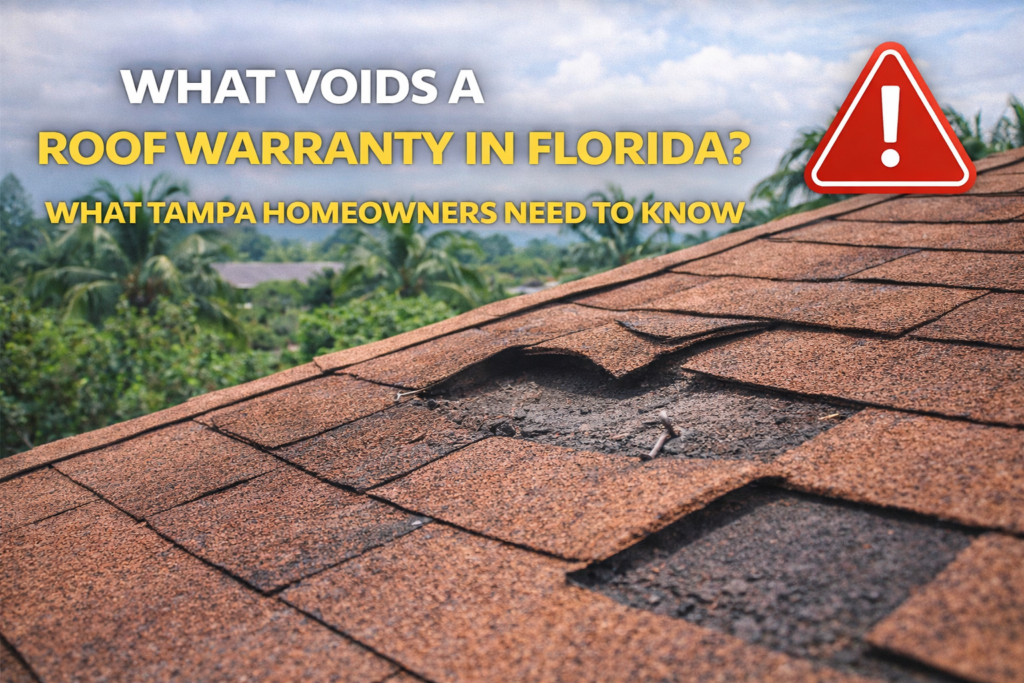
Published by Tampa Premier Roofing | Tampa, FL
When a roofing contractor installs a new roof on your Tampa home, you typically receive two separate warranties: a manufacturer’s warranty covering the roofing materials themselves and a workmanship warranty from the contractor covering the installation. Together, these warranties represent a significant part of the value of a new roof — the assurance that if something fails prematurely, you have recourse.
The problem is that both warranties come with conditions, exclusions, and requirements that many Tampa homeowners never read in full. Actions that seem harmless — walking on the roof to clean gutters, letting a satellite dish installer access the roof, adding solar panels years later — can void coverage in ways that only become apparent when you file a claim and the manufacturer or contractor denies it.
This guide covers exactly what voids both types of roof warranties in Florida, the specific mistakes Tampa homeowners make that unknowingly eliminate their coverage, what enhanced warranty options exist and what they actually provide, and how to protect your warranty coverage for the full term. If you want to understand the warranty status of your current roof or are evaluating a new installation, Tampa Premier Roofing offers free inspections and honest guidance on warranty coverage at no obligation.
Understanding the Two Types of Roof Warranties
Before getting into what voids warranties, it is important to understand what you actually have — because many Tampa homeowners conflate the two types of coverage and do not realize that a void in one does not necessarily affect the other.
Manufacturer’s Material Warranty
The manufacturer’s warranty — issued by the shingle, tile, or metal roofing product manufacturer — covers defects in the roofing material itself. If shingles fail prematurely due to a manufacturing defect, if tiles crack under normal conditions, or if a metal roof coating fails before its rated lifespan, the manufacturer’s warranty is what provides recourse.
Standard manufacturer’s warranties for quality asphalt shingles in Florida range from 25 to 50 years for the material itself, with wind warranties typically ranging from 110 to 130 mph for standard products and up to 150 mph or higher for premium impact-resistant products. These warranties are often prorated — meaning coverage decreases as the roof ages — and they typically cover only the material cost, not the labor to remove and reinstall the roof.
The key point about manufacturer’s warranties: they are issued to you as the homeowner and transfer with the home when you sell, but they have specific conditions that must be met for coverage to remain valid. Those conditions include installation by a licensed contractor, installation according to the manufacturer’s specifications, and the absence of certain actions after installation that the manufacturer considers damaging to the product.
Contractor Workmanship Warranty
The workmanship warranty — issued by the roofing contractor — covers the installation itself. If a roof leaks because of an installation error, improper flashing, incorrect fastener patterns, or any other issue attributable to how the roof was installed rather than a product defect, the workmanship warranty is what provides recourse.
Workmanship warranties vary enormously in duration and scope. Budget contractors may offer one to two years; established reputable Tampa contractors typically offer five to ten years on workmanship. Premium manufacturer-certified programs — discussed in more detail below — include enhanced workmanship warranties of up to 25 or even 50 years when specific installation standards are met.
The workmanship warranty is only as valuable as the contractor who issued it. A warranty from a contractor who goes out of business, relocates, or stops operating in Tampa is worthless — which is one of the significant practical risks of hiring storm-chasing contractors who come to Tampa after hurricane events and leave before warranty issues emerge.
What Voids a Manufacturer’s Roof Warranty in Florida
Installation by an Unlicensed or Non-Authorized Contractor
This is the most common cause of voided manufacturer warranties in Florida — and it is entirely preventable. Most major shingle and roofing product manufacturers require installation by a licensed contractor as a condition of their warranty. Some premium warranty programs go further, requiring installation by a contractor who has completed manufacturer-specific certification training.
In Florida, a licensed roofing contractor holds either a state Certified Roofing Contractor license (prefix CCC) or a county-registered contractor license. Installation by anyone who does not hold the appropriate Florida license — including handymen, general contractors without roofing certification, or unlicensed laborers — can void the manufacturer’s warranty entirely from day one of installation.
This creates a specific risk in Tampa’s post-hurricane environment when storm-chasing contractors arrive and begin working quickly. A contractor who cannot provide a verifiable Florida roofing license number is a contractor whose work may not be covered by any manufacturer’s warranty, regardless of what products are installed.
Installation That Deviates From Manufacturer Specifications
Manufacturer warranties cover their products when installed correctly — according to their published installation specifications. Deviations from these specifications void coverage, even when the deviations are invisible and the roof looks correct from the ground.
Common installation deviations that void manufacturer warranties:
- Incorrect fastener patterns — most manufacturers specify exact nail placement zones and minimum fastener counts per shingle. Installing shingles with fewer fasteners or outside the specified nailing zone is a warranty-voiding deviation
- Improper exposure — installing shingles with more exposure than specified reduces the overlap between courses and is a warranty-voiding deviation
- Wrong underlayment — manufacturer warranties often specify minimum underlayment requirements. Installing a lower-grade underlayment than specified voids coverage
- Insufficient ventilation — most manufacturers include ventilation requirements as a warranty condition. A roof installed over an attic with inadequate ventilation does not meet the conditions for full warranty coverage
- Improper starter strip installation — missing or incorrectly installed starter strips at eaves and rakes is a common installation shortcut that voids warranty coverage for wind damage at those locations
The challenge for Tampa homeowners is that these deviations are essentially impossible to verify without a detailed installation inspection — and by the time a warranty claim is filed, the deviations may have been covered by subsequent layers of roofing material or may require expert reconstruction to establish.
This is why choosing a reputable, manufacturer-certified contractor matters: their installation quality is the primary protection against warranty-voiding deviations.
Failure to Obtain Required Permits
Florida building permits for roof replacements serve multiple purposes — one of which is ensuring that the installation meets the Florida Building Code requirements that many manufacturers incorporate by reference into their warranty conditions. A roof installed without the required permits in Tampa has not been verified to meet those code requirements, and a manufacturer can legitimately argue that uninspected work does not qualify for full warranty coverage.
Beyond the manufacturer’s warranty implications, unpermitted roofing work in Tampa creates insurance complications, resale disclosure requirements, and potential fines from the city. There is no legitimate reason for a full roof replacement to proceed without the required permit, and any contractor who suggests skipping permits to save time or money is creating risks that far exceed any cost savings.
Post-Installation Modifications Without Manufacturer Approval
Any modification to a roof after installation that was not approved by the manufacturer can void warranty coverage — at minimum for the affected area, and potentially for the entire roof if the modification creates conditions that affect the overall roofing system.
The most common post-installation modifications that void warranties on Tampa roofs:
- Installing solar panels — penetrating the roof surface for solar panel mounting creates punctures that the manufacturer did not account for in the warranty. Most manufacturers have specific requirements for how solar-related penetrations must be made and sealed; work done without following these requirements voids coverage in the affected area
- Adding satellite dishes or antennas — roof-mounted dishes and antennas require penetrations that create potential infiltration points. Improper installation or sealing of these penetrations voids coverage around the penetration location
- Installing additional HVAC equipment — rooftop AC units, exhaust fans, or other mechanical equipment added after installation creates new penetrations and foot traffic patterns that affect warranty coverage
- Applying coatings or sealants not approved by the manufacturer — some homeowners apply roof coating products to extend lifespan or address minor leaks; applying unapproved coatings can void the manufacturer’s warranty
The key principle: if anything is going to be done to your roof after installation that involves penetrating the surface, adding load, or applying products to the surface — check with the manufacturer or a certified contractor before proceeding.
Improper or Unauthorized Repairs
Having roof repairs performed by an unqualified contractor — or attempting DIY repairs on a warranted roof — can void manufacturer coverage if the repairs are done improperly and create conditions that lead to further damage. This is not about prohibiting all repairs; it is about requiring that repairs be done correctly and, in some premium warranty programs, by a certified contractor using approved materials.
The practical implication for Tampa homeowners: when a warranted roof needs repair, use a licensed contractor who is familiar with the manufacturer’s requirements for the specific product installed. A repair done with mismatched materials or incorrect technique in a location that later causes further damage gives the manufacturer legitimate grounds to challenge warranty coverage for the resulting claim.
Neglect and Lack of Maintenance
Most manufacturer warranties include a requirement that the homeowner maintain the roof in a reasonable condition and address known issues promptly. A warranty claim filed for a leak that can be traced to a maintenance issue — a clogged gutter that caused back-pitching infiltration, an algae accumulation that was never addressed and degraded the shingle surface, a cracked pipe boot that was noticed and not repaired — may be denied on grounds that the homeowner failed to maintain the roof as required by the warranty conditions.
This condition creates a specific risk in the context of Florida’s rainy season. A homeowner who notices early signs of a problem in June and puts off addressing it through the summer may find that by the time they address it in September, additional storm and rain exposure has compounded the damage — and the manufacturer can argue that the delay contributed to the extent of the loss.
Walking on the Roof Incorrectly
Some manufacturer warranties include provisions about foot traffic on the roof surface. Tile roofs are the most sensitive — concrete and clay tiles crack when stepped on incorrectly, and damaged tiles are explicitly excluded from warranty coverage when the damage is attributable to improper foot traffic. Shingle warranties are less restrictive on this point, but walking on shingles in ways that scuff or dislodge granules — particularly in hot Tampa summers when shingles are more pliable — can be cited as improper use in a warranty dispute.
The practical implication: when roof access is necessary for satellite installation, solar work, HVAC service, or any other purpose, confirm with the roofing contractor that the access is being done in a way that does not compromise warranty coverage.
What Voids a Contractor’s Workmanship Warranty in Florida
The conditions that void a workmanship warranty are different from those that void a manufacturer’s warranty — they tend to focus on actions taken after installation that affect the original work.
Modifications by Other Contractors
If another contractor — a solar installer, HVAC technician, satellite installer, or anyone else — accesses and modifies the roof after installation, the original roofing contractor’s workmanship warranty typically does not cover damage or failures in areas affected by that subsequent work. This is a reasonable limitation: the roofing contractor cannot be responsible for work they did not perform.
The implication for Tampa homeowners: if you are having any work done on the roof after the original installation, notify your roofing contractor first. A reputable contractor will either perform the penetrations and modifications themselves under the warranty, provide guidance on how subsequent contractors must access the roof to preserve coverage, or formally acknowledge the area is being excluded from warranty coverage going forward.
Damage Caused by Homeowner Actions
Workmanship warranties exclude damage caused by the homeowner’s own actions — walking on the roof in ways that cause damage, applying products that were not part of the original installation, attaching equipment to the roof without contractor guidance, or any other direct homeowner action that causes or contributes to a failure.
Acts of God and Storm Damage
Workmanship warranties cover installation quality — not storm damage. Hurricane damage, hail impacts, or wind-driven debris damage are insurance matters, not workmanship warranty matters. A roof that was properly installed but fails due to hurricane-force winds exceeding its rated capacity has not failed due to poor workmanship — the storm exceeded the design parameters of the installation.
This distinction matters for Tampa homeowners because storm-related failures are sometimes mischaracterized as workmanship failures. A contractor who installed correctly is not liable for damage from a storm that exceeded the wind resistance rating of the installed materials. However, a contractor who installed shingles with incorrect fastener patterns, leaving the roof less wind-resistant than it should have been, is responsible if those installation deficiencies contributed to storm damage.
Enhanced Warranty Programs: What They Offer and What They Require
Beyond standard manufacturer and workmanship warranties, most major roofing manufacturers offer enhanced warranty programs that provide significantly better coverage in exchange for meeting specific installation requirements. These programs are worth understanding because they represent a meaningful upgrade in coverage — but only if you actually qualify for them.
GAF System Plus and Master Elite Programs
GAF — one of the largest shingle manufacturers in North America — offers enhanced warranty coverage through its System Plus warranty and its Master Elite contractor certification program. To qualify for a System Plus warranty, the installation must use a complete GAF roofing system — not just GAF shingles but also GAF underlayment, GAF starter strips, GAF ridge cap, and other GAF components. This full-system requirement ensures installation consistency and gives GAF confidence that the warranty conditions have been met.
The GAF Master Elite program is a contractor certification that only about 3% of U.S. roofing contractors hold. Master Elite contractors are authorized to offer GAF’s Golden Pledge warranty — a lifetime warranty covering both materials and workmanship, including 25-year coverage against contractor workmanship defects. This is significantly more comprehensive than a standard contractor workmanship warranty.
Owens Corning Preferred and Platinum Programs
Owens Corning offers similar tiered programs through its Preferred and Platinum contractor certification levels. Platinum contractors can offer Owens Corning’s Total Protection Roofing System warranty, which provides enhanced coverage for both materials and workmanship when a complete Owens Corning system is installed.
What Enhanced Programs Actually Cover
Enhanced manufacturer warranty programs generally provide:
- Extended or lifetime material coverage — versus the standard prorated material warranty
- Non-prorated coverage periods — meaning the full replacement cost rather than a depreciated value is covered during the enhanced coverage term
- Workmanship coverage included — typically 10–25 years of workmanship protection backed by the manufacturer rather than relying solely on the contractor
- Transferability — most enhanced programs transfer to a new owner when the home is sold, adding meaningful value at resale
The tradeoff: enhanced programs require a complete system installation using the manufacturer’s full product line, and they require installation by a certified contractor — which typically means a higher-quality, more expensive contractor than the lowest bidder.
How to Protect Your Roof Warranty in Florida
Understanding what voids your warranty is only useful if you act on that knowledge. Here are the specific steps Tampa homeowners should take to protect warranty coverage for its full term:
Keep Your Warranty Documentation
Store your warranty documentation — both the manufacturer’s warranty certificate and the contractor’s workmanship warranty — in a safe location with your home records. Know what products are installed (manufacturer, product line, color) and what the warranty term and conditions are. This documentation is essential if you ever need to file a claim and is required for the warranty to transfer when you sell the home.
Get the Closed Permit Documentation
After your roof installation is complete, obtain the closed permit documentation from your contractor. This confirms that the work was permitted, inspected, and approved — which is important for both warranty validity and future insurance and resale matters. A reputable contractor provides this automatically; if yours does not, request it specifically.
Schedule Annual Inspections
Annual professional inspections serve dual warranty protection purposes: they document the roof’s condition over time (protecting against claims that damage developed gradually and was ignored), and they identify any issues early enough to address them before they become warranty-relevant failures. Tampa Premier Roofing provides free annual inspections with photo documentation — there is no cost reason to skip this protection.
Notify Your Contractor Before Any Post-Installation Work
Before any contractor other than your original roofer accesses or modifies your roof — solar installation, satellite dishes, HVAC work, any other roof penetration — contact your roofing contractor first. Get written acknowledgment of how the work is to be performed and what effect, if any, it has on your warranty coverage. This protects you from discovering after the fact that a subsequent contractor’s work has voided your coverage.
Address Maintenance Issues Promptly
The manufacturer’s warranty maintenance requirement is not just contractual language — it is a practical protection. Addressing known issues promptly prevents the compounding that creates larger and more expensive problems, and it eliminates the grounds for a manufacturer to argue that homeowner neglect contributed to a warranty claim. Keep records of any maintenance performed — dates, what was done, and by whom.
Use Licensed Contractors for All Roof Work
Every contractor who touches your roof after installation — for repairs, modifications, or maintenance — should be a licensed Florida roofing contractor. Using unlicensed labor for any roof work creates warranty vulnerability and creates the personal liability exposure that comes with uninsured workers on your property.
Warranty Considerations When Buying a Tampa Home
If you are purchasing a Tampa home and the roof has been recently replaced, the transferability of the existing warranty is a meaningful part of what you are buying. Here is what to confirm before closing:
- What manufacturer warranty is in place — product name, warranty term, and whether it is standard or an enhanced program
- Whether the warranty is transferable — most manufacturer warranties are transferable, but some require a formal transfer process within a specific window after the home sale
- What workmanship warranty remains — and whether the contractor who issued it is still operating in Tampa
- Whether there is a closed permit on record for the roof installation — confirm this through the City of Tampa’s permit records, not just the seller’s representations
- Whether the installation was by a licensed Florida roofing contractor — verifiable through the Florida DBPR at myfloridalicense.com
A recent roof with a transferable enhanced manufacturer warranty and a licensed contractor’s workmanship warranty is a meaningful asset. A recent roof with no documentation, no permit on record, and an unknown contractor has none of that value — even if the shingles look new.
Frequently Asked Questions
Q: How long is a typical roof warranty in Florida?
There are two separate warranties. The manufacturer’s material warranty for quality asphalt shingles typically ranges from 25 to lifetime, though these are often prorated after an initial period. Standard contractor workmanship warranties in Florida range from 1–10 years, with reputable contractors offering 5–10 years. Enhanced manufacturer programs like GAF Golden Pledge can provide lifetime material coverage and up to 25 years of workmanship coverage when installed by a certified contractor.
Q: Does adding solar panels void my roof warranty in Florida?
It can — particularly if the penetrations are not made according to the manufacturer’s specifications for post-installation modifications. Most manufacturers have specific requirements for how roof penetrations must be made and sealed to preserve warranty coverage. Before any solar installation, contact your roofing contractor and the shingle manufacturer to confirm the proper process. Solar installations done without following these requirements can void coverage in the affected areas.
Q: Does a Florida roof warranty transfer when I sell my home?
Most manufacturer warranties are transferable with proper documentation, though some require a formal transfer process within a specific window after the sale. The contractor’s workmanship warranty may or may not be transferable depending on the contractor’s terms. Enhanced programs like GAF Golden Pledge are explicitly transferable and add meaningful value at resale. Always confirm warranty transferability as part of the home sale process and provide the buyer with all warranty documentation at closing.
Q: What should I do if my roofing contractor refuses to honor the workmanship warranty?
First, review the warranty document carefully to confirm the claim falls within the coverage terms. Then submit a written claim request to the contractor with documentation of the issue — photos and dates. If the contractor refuses to respond or denies a valid claim, you can file a complaint with the Florida Department of Business and Professional Regulation (DBPR) against the contractor’s license. For significant dollar amounts, consulting a Florida construction attorney may be warranted.
Q: Does homeowners insurance cover the same things as a roof warranty?
No — they cover different things. Homeowners insurance covers sudden and accidental damage from specific events like storms, hail, fire, and wind. Roof warranties cover manufacturing defects in the roofing material and installation quality defects from the contractor. A leak caused by a manufacturing defect is a warranty claim. A leak caused by storm damage is an insurance claim. A leak caused by poor installation is a workmanship warranty claim. Understanding which applies to your situation is the first step in pursuing the right recourse.
Q: Can a contractor void my manufacturer’s warranty?
Yes — a contractor who installs the product in violation of the manufacturer’s specifications effectively voids the warranty from the moment of installation. This is one of the primary reasons to verify that your contractor is licensed, experienced with the specific products being installed, and willing to provide documentation of their installation practices. At Tampa Premier Roofing, we install to manufacturer specifications on every project and provide documentation of the installation for your records.
Q: How do I know if my roof was installed to manufacturer specifications?
The most reliable way is a post-installation inspection by a licensed contractor who is familiar with the manufacturer’s installation requirements for the specific product installed. If you have concerns about a recent installation — particularly if it was done by a contractor you cannot verify or at an unusually low price — a professional inspection can identify whether obvious specification deviations are present. Tampa Premier Roofing provides free inspections that include an assessment of installation quality.