

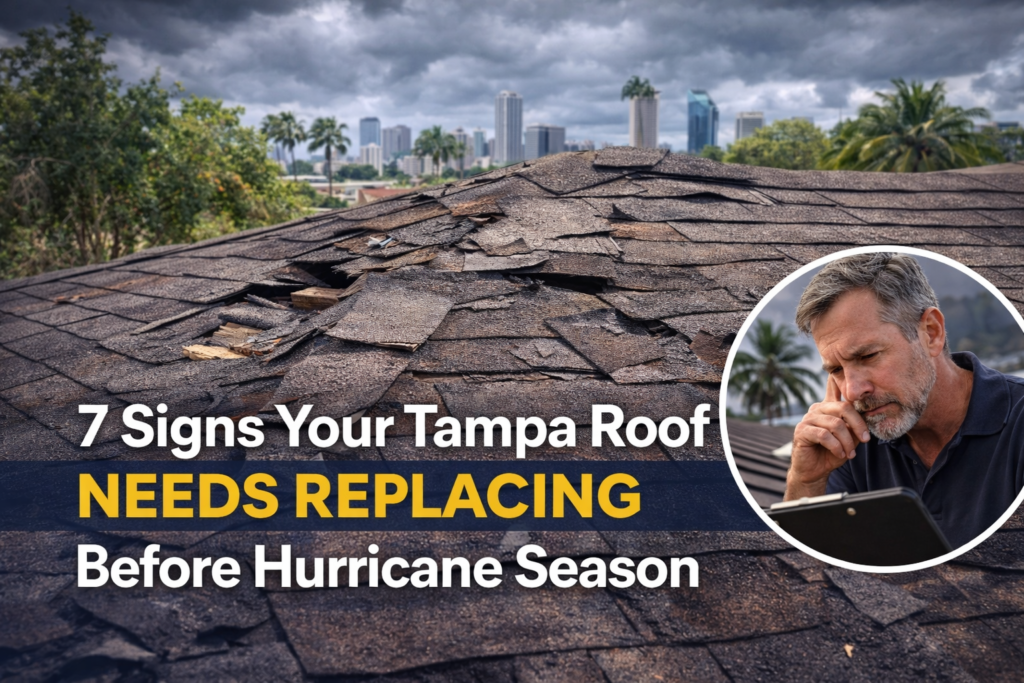
Hurricane season in Florida runs from June 1 through November 30. That gives Tampa homeowners a narrow window each spring to assess the condition of their roof and make critical decisions before the storms arrive.
The problem is most homeowners do not know what to look for. A roof can look fine from the street and still have serious vulnerabilities that a Category 1 storm will exploit in minutes. By the time you see a water stain on your ceiling, the damage is already done — and your insurance claim just got a lot more complicated.
This guide covers the 7 most important warning signs that your Tampa roof may need replacing before hurricane season hits. If you recognize any of these signs, do not wait. A free roof inspection from Tampa Premier Roofing takes less than an hour and could save you tens of thousands of dollars in storm damage.
Sign #1: Your Roof Is More Than 15–20 Years Old
In most parts of the country, an asphalt shingle roof lasts 25–30 years. In Tampa, that timeline is significantly shorter.
Florida’s climate is brutal on roofing materials. The combination of intense UV exposure, high humidity, frequent rain, and hurricane-force winds degrades shingles, flashing, and underlayment far faster than in northern states. A 15-year-old Tampa roof that looks okay from the ground may have underlayment that is cracked, brittle, and completely unable to handle a serious storm.
What to do: If your roof is 15 years or older, schedule a professional inspection before June. Even if it passes inspection, you will have documentation of its condition — which matters enormously if you need to file an insurance claim later.
Sign #2: Missing, Cracked, or Curling Shingles
This is one of the most visible signs and one of the most dangerous to ignore going into storm season.
Missing shingles create an open entry point for water. Cracked shingles have lost their weatherproofing integrity. Curling shingles — where the edges lift upward or the center cups downward — are a sign the shingle has dried out and is no longer lying flat against the roof deck.
In a hurricane, wind gets under lifted shingle edges and can peel entire sections of your roof in seconds. What looked like a minor cosmetic issue becomes catastrophic structural damage.
- Granules in your gutters are a sign shingles are breaking down
- Dark patches on shingles indicate moisture damage
- Shingles that look wavy or uneven from the ground need immediate attention
A few missing shingles can often be repaired. But if the damage is widespread across multiple areas of the roof, replacement is almost always the smarter long-term investment — especially before hurricane season.
Sign #3: Granule Loss in Your Gutters
Asphalt shingles are coated with small granules that protect the shingle material from UV rays and provide fire resistance. When you start finding significant amounts of these granules in your gutters or at the base of your downspouts, your shingles are telling you they are near the end of their life.
Some granule loss is normal on new roofs as excess granules shed during the first year. But heavy, consistent granule loss on an older roof means the protective coating is gone. Without it, the asphalt layer bakes in the Florida sun, dries out, and becomes brittle — exactly the condition that leads to catastrophic failure in a storm.
Check your gutters after the next heavy rain. If you see what looks like coarse black sand collecting at the downspout outlets, call Tampa Premier Roofing for a free inspection.
Sign #4: Sagging Sections of Roof
A sagging roofline is never a cosmetic issue. It is a structural one — and it is serious.
Sagging happens when the roof deck (the plywood or OSB underneath the shingles) has been compromised by moisture, rot, or inadequate support. In Florida, this is almost always caused by long-term water intrusion that went undetected — a slow leak around a vent, flashing failure, or a small area of missing shingles that allowed years of moisture to accumulate.
A sagging roof section will not survive a direct hit from a storm. The weight of water, combined with wind uplift forces, can cause a partial or full roof collapse.
If you notice any dipping, sagging, or uneven areas when looking at your roofline from the street or your yard, treat it as an emergency. This is not a repair situation — this is a replacement situation, and it needs to happen before June.
Sign #5: Daylight Visible in Your Attic
One of the simplest inspections you can do yourself: go into your attic on a bright day and turn off the lights. Look up at the roof decking.
If you can see any daylight coming through — even small pinpoints — you have gaps in your roof that water and wind can exploit. These gaps are often where two roof planes meet, around chimneys or vents, or at the ridge line.
While you are up there, also look for:
- Water stains or dark streaks on the rafters or decking — signs of existing or past leaks
- Wet or compressed insulation — indicates moisture has been entering
- Mold or mildew growth on wood surfaces — a sign of long-term moisture exposure
- Soft or spongy spots when you press on the decking — indicates rot
Any of these findings in your attic means your roof has already been compromised. Getting a professional assessment before hurricane season is critical — what you find may change from a repair to a full replacement once a contractor sees the full extent of the damage from above.
Sign #6: Flashing That Is Cracked, Lifted, or Missing
Flashing is the metal material installed at every vulnerable joint on your roof — around the chimney, skylights, vents, valleys where two roof planes meet, and along the edges. Its job is to prevent water from getting into those seams.
Flashing failure is one of the leading causes of roof leaks in Tampa. The constant expansion and contraction from Florida’s extreme heat, combined with wind and rain, works flashing loose over time. In older homes, the original flashing may be made from materials that have simply reached the end of their lifespan.
Signs of flashing problems:
- Visible gaps or cracks around your chimney or skylights
- Rust staining on exterior walls below roof joints
- Water stains on interior walls or ceilings near these areas
- Flashing that has lifted away from the roof surface
Flashing issues are sometimes repairable on their own, but in many cases when we inspect a roof with significant flashing failure, we find that the underlying shingles and decking have also been damaged by the years of water intrusion that led to the flashing failure in the first place.
Sign #7: Your Roof Has Already Failed an Insurance Inspection
This one catches Tampa homeowners off guard every year.
In Florida, insurance companies have the right to inspect your roof when you renew your policy or purchase a new one. If your roof fails their inspection — typically due to age, condition, or storm damage — they can require you to replace it as a condition of coverage, or they can non-renew your policy entirely.
With Florida’s insurance market already in crisis, carriers are being extremely aggressive about roof conditions. A roof that was acceptable for coverage three years ago may not be today.
If you have received a letter from your insurance carrier requesting a roof inspection, or if you have been notified that your policy is being non-renewed due to roof condition, do not ignore it. You have a limited window to address the issue and maintain coverage.
Tampa Premier Roofing works directly with all major Florida carriers and can provide the documentation and replacement work needed to satisfy their requirements. Contact us here to get started.
What Tampa Homeowners Should Do Right Now
If any of the 7 signs above apply to your home, here is your action plan:
- Schedule a free professional roof inspection before June 1
- Get written documentation of your roof’s current condition with photos
- Review your homeowners insurance policy — specifically your roof coverage type (ACV vs RCV) and your hurricane deductible
- If replacement is recommended, act early — roofing contractors get booked solid as hurricane season approaches and material costs tend to rise
- Do not wait for a storm to tell you what your inspector could have told you in March
At Tampa Premier Roofing, we offer completely free roof inspections with full photo documentation across Tampa, Brandon, and Riverview. We will tell you honestly whether you need a repair, a replacement, or nothing at all — no pressure, no obligation.
schedule online here. We respond within the hour.
Frequently Asked Questions
Q: When is the best time to replace a roof in Tampa before hurricane season?
Ideally, February through April. This gives you time to get inspected, get multiple quotes if needed, schedule the work, and have it fully completed and permitted before June 1. Roofing contractors in Tampa get very busy in May as homeowners rush to prepare — booking early saves time and sometimes money.
Q: How much does a roof replacement cost in Tampa?
The cost varies significantly based on roof size, slope, material type, and the extent of any decking damage found during tear-off. A typical Tampa asphalt shingle replacement ranges from $8,000 to $20,000 for an average-sized home. Metal roofing and tile are higher. The best way to get an accurate number is a free in-person inspection and quote from a licensed contractor.
Q: Will my insurance cover a full roof replacement in Tampa?
It depends on your policy and the cause of the damage. If the damage is storm-related, most policies will cover replacement — but the payout depends on whether you have ACV or RCV coverage and your deductible amount. If your roof is simply old and worn, insurance generally will not cover replacement. This is why it is important to document storm damage as soon as it occurs. Tampa Premier Roofing provides free inspections specifically designed to document storm-related damage for insurance claims.
Q: How long does a roof replacement take in Tampa?
Most residential roof replacements in Tampa are completed in 1–2 days for standard asphalt shingle roofs. Larger homes, tile roofs, or roofs with significant decking damage may take 3–5 days. We work efficiently to minimize disruption to your household.
Q: What roofing material is best for Tampa’s hurricane climate?
Metal roofing offers the highest wind resistance and longevity in Florida’s climate — properly installed metal roofs can withstand winds over 140 mph. Concrete tile is also extremely durable. Architectural asphalt shingles rated for high-velocity hurricane zones offer good protection at a lower price point. The right choice depends on your budget, your home’s structure, and your long-term plans.
Q: Can I get a free roof inspection before hurricane season in Tampa?
Yes. Tampa Premier Roofing offers completely free roof inspections with full photo documentation at no charge and no obligation. We serve Tampa, Brandon, Riverview, and surrounding areas and can typically schedule within 48 hours.