

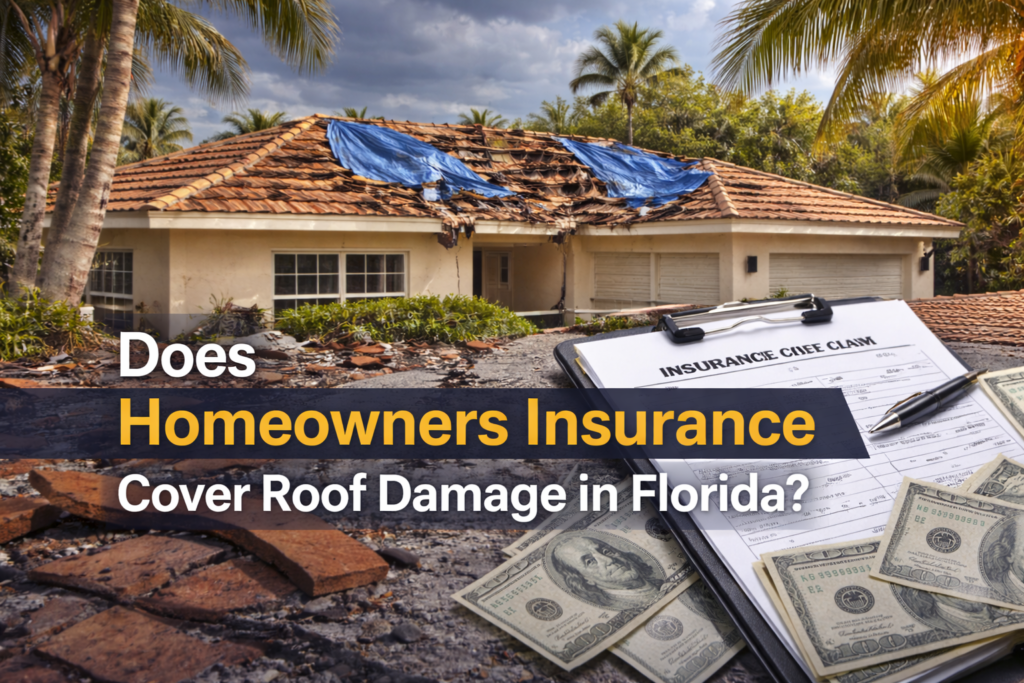
If you have a damaged roof in Florida, the first question most homeowners ask is simple: will my insurance pay for this?
The answer is: it depends — and understanding exactly what it depends on could be the difference between a fully covered roof replacement and a five-figure bill you pay out of pocket.
This guide breaks down exactly how Florida homeowners insurance handles roof damage, what is covered and what is not, how recent Florida law changes have affected your policy, and what steps to take to give your claim the best possible chance of approval. If you have roof damage in Tampa and are not sure where to start, Tampa Premier Roofing offers free inspections with full photo documentation specifically designed to support insurance claims.
The Short Answer: Storm Damage Is Usually Covered — Wear and Tear Is Not
Florida homeowners insurance generally covers roof damage caused by sudden, accidental events — things like:
- Hurricane and tropical storm wind damage
- Hail damage
- Lightning strikes
- Falling trees or debris
- Fire damage
What insurance does NOT cover is damage caused by:
- Normal wear and tear over time
- Lack of maintenance — clogged gutters, ignored minor leaks, deteriorated flashing
- Manufacturer defects in roofing materials
- Damage that existed before your policy started
- Mold, rot, or pest damage that developed gradually
The core principle Florida carriers use is this: insurance covers sudden and accidental damage, not gradual deterioration. If an adjuster can argue that your roof was already failing before the storm hit, they will — and it can significantly reduce or eliminate your payout.
This is exactly why getting a professional inspection before filing a claim matters. At Tampa Premier Roofing, we document storm damage with photos and detailed reports that clearly establish the cause of damage — making it much harder for a carrier to attribute it to pre-existing wear.
ACV vs. RCV: The Most Important Thing In Your Florida Roof Policy
Before anything else, you need to know whether your policy pays Actual Cash Value (ACV) or Replacement Cost Value (RCV) for roof claims. This single distinction can mean a difference of thousands of dollars.
Actual Cash Value (ACV)
ACV pays you what your roof is worth today — after depreciation. A 15-year-old asphalt shingle roof that originally cost $15,000 to install might only be worth $4,000–$5,000 in ACV terms because the insurance company accounts for age and wear.
In Florida, carriers have increasingly been moving customers to ACV-only policies for roofs, especially older ones. If your roof is over 10–15 years old, there is a real chance your policy only pays ACV — meaning you would owe the difference between what the carrier pays and what a new roof actually costs.
Replacement Cost Value (RCV)
RCV pays what it actually costs to replace your roof with comparable materials at today’s prices — regardless of the age or condition of your old roof. This is significantly better coverage and the standard you should be aiming for.
How RCV typically works: the carrier first pays you the ACV amount after your deductible. Once you complete the repairs and submit final invoices, they release the remaining depreciation funds — called the recoverable depreciation.
If you are not sure which type of coverage you have, look for the word ‘depreciation’ in your roof coverage section or call your agent and ask directly: ‘Is my roof covered at ACV or RCV?’
Florida’s Hurricane Deductible: What Tampa Homeowners Need to Know
This catches Tampa homeowners off guard every year. Florida policies do not have a single flat deductible for all claims. Most policies have a separate, higher hurricane deductible that applies specifically to wind damage from named storms.
Florida hurricane deductibles are typically calculated as a percentage of your home’s insured value — not a flat dollar amount. Common options are 2%, 5%, or 10%. On a home insured for $350,000, those deductibles look like this:
- 2% deductible = $7,000 out of pocket
- 5% deductible = $17,500 out of pocket
- 10% deductible = $35,000 out of pocket
If your roof replacement costs $18,000 and you have a 5% hurricane deductible on a $350,000 home, you would owe $17,500 before insurance pays a single dollar — effectively making the claim almost worthless.
This is not a reason to avoid filing — it is a reason to know your deductible before the storm season starts and to weigh it against the cost of proactive replacement vs. waiting for storm damage.
How Florida’s SB 2-D Law Changed Roof Insurance in 2023
In 2022 and 2023, Florida passed significant insurance reform legislation — most notably Senate Bill 2-D — that fundamentally changed how roof claims are handled in the state. If you have not checked your policy recently, some of these changes may have affected your coverage without you realizing it.
Key changes that affect Tampa homeowners:
- Carriers can now offer policies that only cover roofs at ACV if the roof is over a certain age — often 10 or 15 years — rather than being required to offer full RCV coverage
- Insurers can deny coverage for roofs with more than 25% damage if the roof is older than a certain threshold, rather than being required to cover a full replacement
- Assignment of Benefits (AOB) restrictions were tightened, limiting the ability of contractors to file claims on behalf of homeowners — meaning you need to be more involved in your own claim process
- One-way attorney fee provisions were eliminated, making it harder to sue carriers and recover legal fees — which has reduced the leverage homeowners had when disputing denied claims
The bottom line: Florida’s insurance market has shifted significantly against homeowners in recent years. Carriers have more tools to limit payouts, and homeowners have fewer tools to fight back. Getting detailed professional documentation at the time of damage is more important than ever.
What Happens if My Roof Claim Gets Denied?
A denial is not the end. Florida homeowners have several options when a claim is denied or underpaid:
Request a Re-Inspection
You have the right to request that the carrier send a different adjuster for a second look. If you have additional documentation — photos, a written inspection report from a licensed contractor — submit it with your re-inspection request.
Hire a Public Adjuster
A public adjuster is an independent licensed professional who works for you — not the insurance company — to negotiate your claim. They typically charge a percentage of the final settlement (usually 10–20%) but can significantly increase the payout on underpaid claims.
Invoke the Appraisal Process
Most Florida policies include an appraisal clause. If you and your carrier disagree on the amount of damage, each party hires their own appraiser and an umpire makes the final call. This is often faster and cheaper than litigation.
File a Complaint With the Florida Department of Financial Services
If you believe your carrier is acting in bad faith — unreasonably delaying, denying without cause, or lowballing — you can file a complaint with the Florida Department of Financial Services. This creates a formal record and sometimes motivates carriers to resolve claims more fairly.
How to Give Your Tampa Roof Claim the Best Chance of Approval
Based on what we see in Tampa roof claims regularly, here are the steps that make the biggest difference:
- Get a professional inspection immediately after storm damage — before calling your carrier. Document everything with photos before any temporary repairs are made.
- Keep records of all roof maintenance — receipts for cleaning, repairs, or inspections show you have been maintaining the roof and counter the ‘neglect’ argument carriers use to deny claims.
- Read your policy before storm season — know your deductible, your coverage type (ACV vs RCV), and any age-based exclusions so you are not surprised after the storm.
- Do not let the insurance adjuster inspect alone — be present, bring your contractor’s report, and walk them through every damage point your inspector documented.
- Do not sign anything or accept a settlement on the day of the adjuster visit — review it carefully and compare it to your contractor’s estimate before agreeing.
- Do not sign an Assignment of Benefits — this transfers your insurance rights to a contractor and can complicate or even void your claim.
The Tampa Premier Roofing team provides free roof inspections with full photo documentation designed to support insurance claims. We work with all major Florida carriers and know exactly how to document damage in a way that holds up through the claims process.
The Bottom Line
Florida homeowners insurance does cover roof damage — but only under specific circumstances, and the payout depends heavily on your coverage type, your deductible, your roof’s age, and how well the damage is documented at the time of loss.
The most important things you can do as a Tampa homeowner are: know your policy before storm season, get professional documentation of any damage immediately, and do not accept a low settlement without pushing back.
If you have roof damage and are not sure whether your insurance will cover it, start with a free inspection. We will assess your roof, document the damage with photos, and give you an honest assessment of what your carrier is likely to cover — at no charge and no obligation.
Schedule your free Tampa roof inspection here — we respond within the hour.
Frequently Asked Questions
Q: Does Florida homeowners insurance cover roof replacement due to age?
Generally no. Insurance covers sudden, accidental damage — not wear and tear from age. However, if a storm damages a roof that was already aging, the carrier must still cover the storm-related damage even if the roof was old. The debate often comes down to what percentage of the damage is storm-related vs. pre-existing, which is why professional documentation is critical.
Q: My roof is 20 years old. Can I still get insurance to cover a replacement in Florida?
It depends on your policy and your carrier. Under recent Florida law changes, many carriers now offer ACV-only coverage for roofs over 10–15 years old, meaning they will only pay the depreciated value — not full replacement cost. Some carriers will non-renew policies with older roofs entirely. If your roof is aging, check your policy terms and consider proactive replacement before hurricane season to avoid coverage gaps.
Q: What is the difference between a hurricane deductible and a regular deductible in Florida?
A standard deductible is a flat dollar amount (e.g., $1,000 or $2,500) that applies to most claims. A hurricane deductible is a separate, higher amount that applies specifically to wind damage from named tropical storms or hurricanes. In Florida, hurricane deductibles are calculated as a percentage of your home’s insured value — typically 2%, 5%, or 10% — which can translate to thousands or tens of thousands of dollars out of pocket.
Q: Will filing a roof insurance claim raise my rates in Florida?
Possibly. In Florida’s difficult insurance market, filing a claim can lead to a premium increase at renewal or, in some cases, non-renewal. However, for significant storm damage, the cost of not filing almost always exceeds the risk of a rate increase. Talk to your agent about the likely impact before filing if you are on the fence about a smaller claim.
Q: How long does a Florida roof insurance claim take to process?
Florida law requires carriers to acknowledge a claim within 14 days and make a coverage decision within 90 days. In practice, straightforward claims can be resolved in 4–8 weeks. Claims with significant damage, disputes over cause, or high volume after a major storm can take considerably longer. Having complete documentation from the start helps speed up the process.
Q: Can Tampa Premier Roofing help me with my insurance claim?
Yes. Tampa Premier Roofing provides free roof inspections with full photo documentation designed specifically to support insurance claims. We work with all major Florida carriers including State Farm, Allstate, Citizens, Progressive, Liberty Mutual, USAA, Farmers, and Nationwide. We can be present during the adjuster inspection and provide the detailed reports your carrier needs to process your claim accurately.
Q: What should I do immediately after a storm damages my Tampa roof?
First, document everything with photos from the ground before any repairs are made. Then call a licensed roofing contractor for a professional inspection — before contacting your insurance carrier. Having an independent inspection report in hand before the adjuster visits gives you documentation to support your claim and a baseline to dispute a low settlement offer. Tampa Premier Roofing offers free post-storm inspections and can usually schedule within 48 hours.