

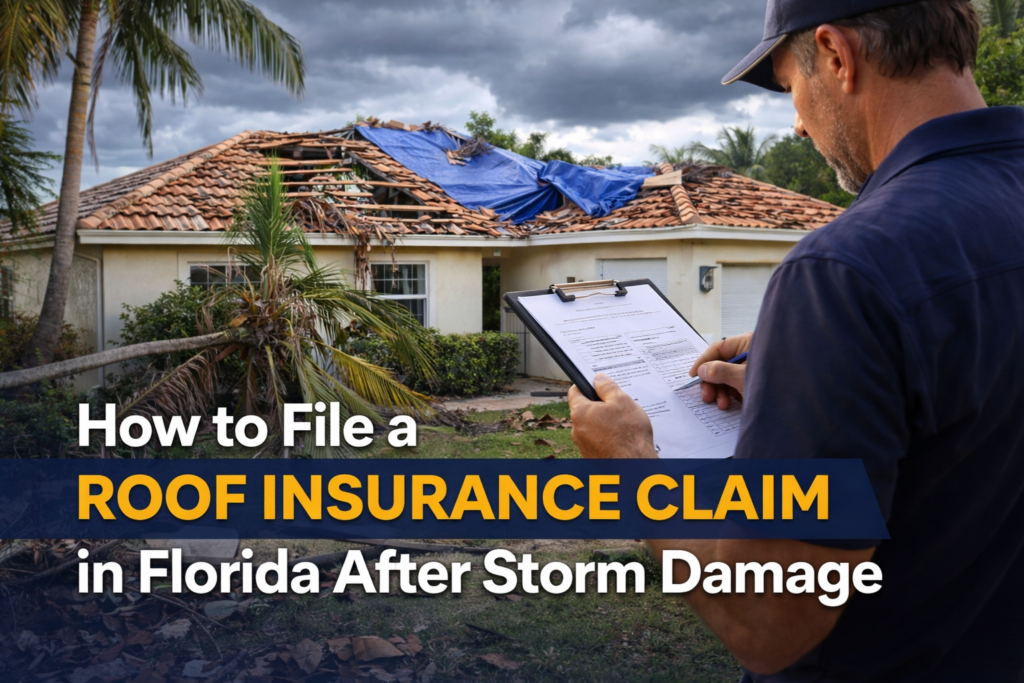
Florida homeowners know the drill — a storm rolls through Tampa, and suddenly you’re staring at missing shingles, water stains on your ceiling, or worse. The good news is that most homeowners insurance policies in Florida cover storm-related roof damage. The bad news is that the claims process can be confusing, slow, and frustrating if you don’t know the steps.
This guide walks you through exactly how to file a roof insurance claim in Florida, what to expect, and how to avoid the mistakes that get claims denied or underpaid.
Step 1: Document the Damage Immediately
The moment it is safe to do so after the storm, document every bit of damage you can see. Do not wait.
- Take photos and videos of your roof from the ground
- Photograph any interior damage — ceiling stains, wet insulation, damaged drywall
- Note the date and time of the storm
- Save any weather alerts or news reports confirming the storm event
The more documentation you have, the stronger your claim. Insurance adjusters look for evidence that the damage was caused by a specific storm event, not pre-existing wear and tear.
Pro tip: If you are not comfortable getting on your roof yourself, do not try. A professional inspection is safer and produces better documentation anyway.
Step 2: Get a Professional Roof Inspection Before Calling Your Insurer
This step is one most homeowners skip — and it is a costly mistake.
Before you file your claim, get an independent inspection from a licensed roofing contractor. Here is why this matters:
- Insurance company adjusters work for the insurance company — not for you
- An independent inspector documents damage the adjuster might overlook or minimize
- You will have a detailed written report and photos to support your claim
- It gives you a baseline to dispute a low settlement offer
At Tampa Premier Roofing, we provide free roof inspections with full photo documentation specifically designed to support insurance claims. We know what carriers look for and how to document it correctly.
Step 3: Review Your Insurance Policy
Before you file, understand what you are working with. Key things to look for in your Florida homeowners policy:
- Dwelling coverage — this is what covers your roof structure
- ACV vs. RCV — Actual Cash Value pays depreciated value; Replacement Cost Value pays what it actually costs to replace the roof today. RCV is significantly better for older roofs.
- Deductible amount — Florida policies often have a separate hurricane deductible which can be 2%–5% of your home’s insured value, not a flat dollar amount
- Exclusions — some policies exclude cosmetic damage or have age-based limitations on roofs over 10–15 years old
Florida law (SB 2-D) has changed how roof claims are handled in recent years. If your roof is older, your carrier may only offer ACV coverage. Understanding your policy before you file saves significant frustration.
Step 4: File Your Claim Promptly
Most Florida insurance policies require you to report damage promptly — typically within 1–2 years of the loss event, though filing sooner is always better. To file:
- Call your insurance carrier’s claims line or file online through their portal
- Provide the date of the storm, a description of the damage, and your documentation
- Request a claim number and write it down — you will need it for every future communication
- Ask when the adjuster will contact you to schedule an inspection
Major Florida carriers include State Farm, Allstate, Citizens, Progressive, Liberty Mutual, USAA, Farmers, and Nationwide. Each has a slightly different claims process but the fundamentals are the same.
Step 5: Be Present for the Insurance Adjuster’s Inspection
When the insurance adjuster comes out, be there — and bring your independent inspection report.
- Walk the adjuster through every damage point your contractor documented
- Provide copies of your photos and the written inspection report
- Do not sign anything or agree to any settlement on the day of the inspection
- Ask the adjuster to explain everything they are and are not including in their estimate
Having your roofing contractor present during the adjuster visit can be extremely valuable. They can speak the same technical language as the adjuster and advocate for a complete, accurate assessment.
Step 6: Review the Settlement Offer Carefully
Once your claim is processed, you will receive a settlement offer. Do not assume it is final or correct.
Common issues with initial settlement offers:
- Depreciation applied too aggressively, lowering your payout significantly
- Some damage items left off the scope of work entirely
- Labor and material costs calculated below current Tampa market rates
- Hurricane deductible applied incorrectly
If the offer seems low, you have options. You can request a re-inspection, hire a public adjuster, or invoke the appraisal process outlined in your policy. Do not let a low initial offer be the end of the conversation.
Step 7: Choose Your Roofing Contractor Carefully
Once your claim is approved, be very careful about who you hire to do the actual work.
Florida has unfortunately seen a surge in roofing scams after storms — contractors who take large deposits and disappear, do shoddy work, or use substandard materials. Red flags to avoid:
- Any contractor who asks you to sign over your insurance benefits (Assignment of Benefits)
- Contractors who approach you door-to-door immediately after a storm
- Anyone who cannot provide a Florida roofing license number
- Contractors who pressure you to sign anything before you have reviewed your settlement
Work with a licensed, insured, locally established contractor who has experience with insurance claim documentation. At Tampa Premier Roofing, we are fully licensed and insured in Florida and specialize in storm damage documentation and insurance claim support.
The Bottom Line
Filing a roof insurance claim in Florida does not have to be overwhelming. The key steps are: document everything immediately, get an independent inspection before calling your carrier, understand your policy, file promptly, and do not accept a low settlement without pushing back.
If you have storm damage and are not sure where to start, the best first move is a free professional inspection. We will assess your roof, document everything with photos, and walk you through exactly what your insurance carrier will need.
Schedule your free Tampa roof inspection here — we respond within the hour.
Frequently Asked Questions
Q: How long do I have to file a roof insurance claim in Florida after a storm?
Florida law generally allows up to 2 years from the date of loss to file a claim, though some policies have shorter windows. Always check your specific policy and file as soon as possible — delays can complicate your claim and make it harder to prove the damage was storm-related.
Q: Will filing a roof insurance claim raise my homeowners insurance premium in Florida?
It can, depending on your carrier and how many claims you have filed previously. However, if you have significant storm damage, the cost of not filing almost always outweighs the potential premium increase. Your roofing contractor and insurance agent can help you weigh the options.
Q: What is the difference between ACV and RCV on a Florida roof claim?
ACV (Actual Cash Value) pays the depreciated value of your roof — meaning if your 15-year-old roof has a 20-year lifespan, they may only pay 25% of replacement cost. RCV (Replacement Cost Value) pays what it actually costs to replace the roof with like materials at today’s prices. RCV coverage is significantly better, especially for older roofs.
Q: Can I get a free roof inspection in Tampa before I file my insurance claim?
Yes. Tampa Premier Roofing offers free roof inspections with full photo documentation at no charge. We recommend getting an independent inspection before contacting your carrier so you have a complete record of the damage.
Q: What if my insurance company denies my roof claim?
A denial is not the end. You can request a re-inspection, submit additional documentation, hire a public adjuster to negotiate on your behalf, or invoke the appraisal clause in your policy. Many denied or underpaid claims are successfully resolved through these processes.
Q: Does Tampa Premier Roofing work with all insurance companies?
Yes. We work with all major Florida carriers including State Farm, Allstate, Citizens, Progressive, Liberty Mutual, USAA, Farmers, and Nationwide. We provide detailed inspection reports and photo documentation that meet the requirements of every major carrier.