

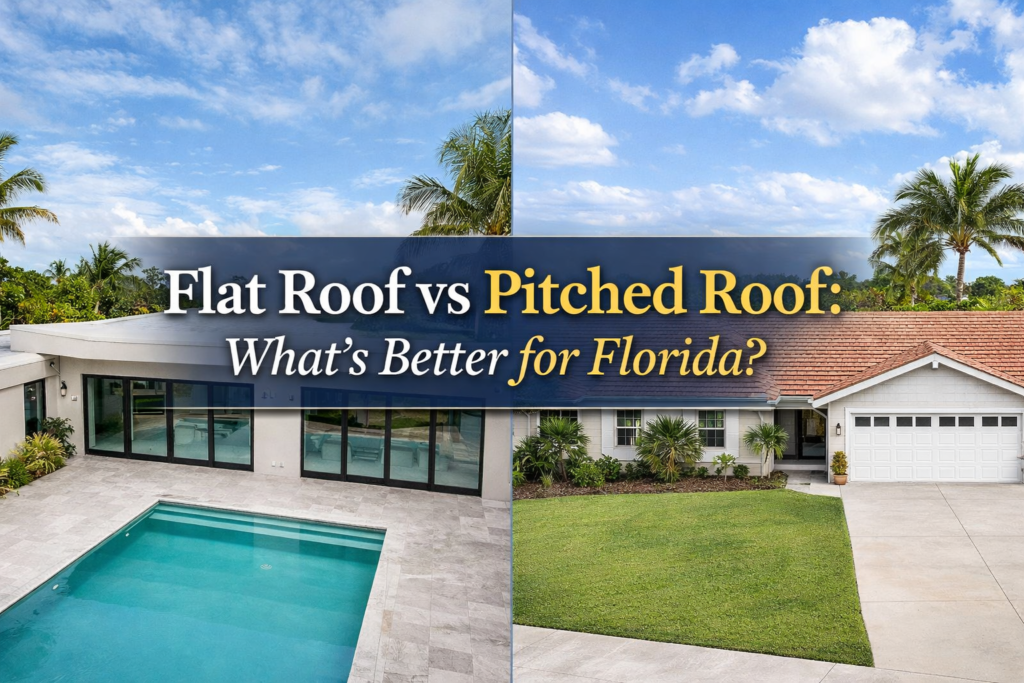
If you’re a homeowner in the Tampa Bay area weighing your roofing options, one of the most important decisions you’ll face is whether to go with a flat roof or a pitched roof. It sounds simple enough, but when you factor in Florida’s unique climate — brutal summer heat, torrential rain, sky-high humidity, and hurricane-force winds — the answer becomes far more nuanced than most homeowners expect.
At Tampa Premier Roofing, we’ve installed, repaired, and replaced thousands of roofs across Tampa Bay. We’ve seen what works and what fails in Florida’s demanding environment. In this comprehensive guide, we’re going to break down everything you need to know about flat roofs and pitched roofs — from materials and performance to cost, lifespan, insurance implications, and what Florida’s building codes require.
By the end, you’ll have a clear picture of which roof type makes the most sense for your home, your budget, and your long-term peace of mind.
Understanding the Difference: Flat Roofs vs Pitched Roofs
Before we compare performance, let’s make sure we’re on the same page about what each roof type actually is.
What Is a Flat Roof?
Despite the name, flat roofs aren’t completely flat. They have a very slight slope — typically between 1/4 inch and 1/2 inch per foot — designed to direct water toward drains or scuppers. This low-slope design is what sets them apart from traditional pitched roofs.
Flat roofs are most commonly found on:
- Commercial and industrial buildings
- Modern and contemporary residential homes
- Florida ranch-style and mid-century homes
- Home additions and garage roofs
- Apartment buildings and multi-family structures
Common flat roof materials include TPO (thermoplastic polyolefin), EPDM rubber, modified bitumen, and built-up roofing (BUR). Each has its own performance characteristics, which we’ll cover later in this guide.
What Is a Pitched Roof?
A pitched roof has a more pronounced slope, typically starting at a 4:12 pitch (rises 4 inches for every 12 inches of horizontal run) and going up from there. Pitched roofs come in many styles, but the most common in Florida include:
- Gable roofs — The classic triangular shape with two sloping sides. Common and cost-effective, but can struggle in high winds.
- Hip roofs — Slopes on all four sides meeting at a ridge at the top. Considered the gold standard for Florida wind resistance.
- Dutch hip roofs — A hybrid of gable and hip styles, offering good aesthetics with improved wind performance.
- Mansard roofs — Four sloped sides with two slopes on each side. Less common in Florida but found in some historic neighborhoods.
Pitched roofs can be covered with a wide range of materials including asphalt shingles, metal panels, clay tile, concrete tile, and slate. In Florida, metal and tile are particularly popular due to their longevity and storm resistance.
How Florida’s Climate Shapes Your Roofing Decision
Florida is not like other states when it comes to roofing. The combination of weather factors we deal with here is truly unique, and it has a direct impact on how long any roof will last — and how much it will cost to maintain.
Heat and UV Radiation
Tampa receives an average of 246 sunny days per year. That sounds great for beach days, but it’s tough on roofing materials. Prolonged UV exposure causes roofing materials to oxidize, crack, and degrade faster than in cooler climates. This is especially true for asphalt shingles, which can lose their protective granules much faster in Florida than they would in, say, Ohio or Michigan.
For flat roofs, heat causes membrane materials to expand and contract repeatedly, which can eventually lead to seam separations and cracks. Light-colored flat roof membranes like TPO reflect sunlight and help manage this thermal cycling better than darker materials.
For pitched roofs, metal roofing handles UV exposure exceptionally well. Tile roofs also perform beautifully in Florida’s heat. Asphalt shingles, while functional, tend to have a shorter lifespan in Florida compared to the manufacturer’s stated estimates — which are usually based on more temperate climates.
Rain and Humidity
Florida averages around 54 inches of rain per year — significantly more than the national average of about 38 inches. Tampa’s rainy season runs from June through September, with intense afternoon thunderstorms that can dump several inches of rain in a matter of hours.
This is where the drainage differences between flat and pitched roofs become critically important. A pitched roof sheds water almost instantly due to gravity. A flat roof, on the other hand, relies on proper drainage infrastructure — scuppers, interior drains, or gutters — to move water off the surface.
When flat roof drains get clogged with leaves, debris, or dirt, water can pond on the surface. Ponding water accelerates membrane deterioration and dramatically increases the risk of leaks. In Florida’s rainy season, this is a constant maintenance concern for flat roof owners.
High humidity also contributes to the growth of algae, moss, and lichen on roofing surfaces. This is especially visible on asphalt shingles (those dark streaks you see on roofs are typically algae growth). Tile and metal roofs are far more resistant to biological growth, making them popular choices in Florida’s humid environment.
Hurricanes and High Winds
This is the factor that defines roofing in Florida more than any other. The Tampa Bay area sits squarely in hurricane territory, and every homeowner needs to think seriously about how their roof will perform when the winds pick up.
Florida’s building code — updated significantly after Hurricane Andrew devastated South Florida in 1992 — is one of the strictest in the nation. All new roofs must be designed and installed to meet specific wind speed requirements based on the home’s location. In Tampa, that typically means wind ratings of 130 mph or higher.
Hip roofs consistently outperform gable roofs in hurricane conditions. Because all four sides are sloped, there’s no flat vertical surface for wind to catch and push against. Studies by the Insurance Institute for Business and Home Safety (IBHS) have shown that hip roofs can reduce wind-related damage significantly compared to gable roofs.
Flat roofs present a different set of wind challenges. Wind can create uplift pressure on flat surfaces, and if the membrane isn’t properly attached at the edges and seams, sections can peel away during a storm. That said, modern flat roofing systems installed by experienced contractors can meet Florida’s wind codes when done correctly.
Flat Roof Materials for Florida: What Are Your Options?
If you’re considering a flat roof for your Florida home, material selection is critical. Here’s a breakdown of the most common flat roofing systems used in Tampa Bay:
TPO (Thermoplastic Polyolefin)
TPO is currently the most popular flat roofing material in both commercial and residential applications. It’s a single-ply membrane that comes in white or light gray, which helps reflect sunlight and reduce cooling costs — a big advantage in Florida’s heat.
- Lifespan: 15–25 years with proper maintenance
- Cost: $6–$10 per square foot installed
- Pros: Energy-efficient, heat-weldable seams, resistant to UV and chemicals
- Cons: Seams can fail over time, requires professional installation
EPDM (Ethylene Propylene Diene Monomer)
EPDM is a synthetic rubber membrane that has been used on flat roofs for decades. It’s typically black, which means it absorbs more heat than TPO — a notable downside in Florida unless a reflective coating is applied.
- Lifespan: 20–30 years
- Cost: $5–$9 per square foot installed
- Pros: Proven durability, flexible in temperature extremes, easy to repair
- Cons: Black color increases heat absorption, seams require adhesive rather than heat welding
Modified Bitumen
Modified bitumen is a multi-layer asphalt-based system that has been a staple of flat roofing for many years. It’s particularly common on older Florida homes and commercial properties.
- Lifespan: 15–20 years
- Cost: $4–$8 per square foot installed
- Pros: Strong and durable, good resistance to foot traffic, widely available
- Cons: Shorter lifespan than TPO or EPDM, can crack in extreme heat without proper maintenance
Spray Polyurethane Foam (SPF)
SPF roofing involves spraying a liquid foam that expands and hardens into a solid, seamless surface. It’s then coated with a protective elastomeric coating. While less common, it’s an excellent option for certain flat roof applications in Florida.
- Lifespan: 20–30 years with re-coating every 10–15 years
- Cost: $6–$12 per square foot installed
- Pros: Completely seamless (no seam failures), excellent insulation value, self-flashing
- Cons: Requires professional application, must be re-coated periodically, UV-sensitive without coating
Pitched Roof Materials for Florida: What Are Your Options?
Pitched roofs offer a wider variety of material choices, and each performs differently in Florida’s climate. Here’s what you need to know:
Asphalt Shingles
Asphalt shingles remain the most common roofing material in the United States, and they’re widely used in Tampa Bay. They’re affordable and come in a wide range of colors and styles.
- Lifespan: 15–25 years in Florida (shorter than the 25–30 years expected in cooler climates)
- Cost: $8,000–$18,000 for an average Tampa home
- Pros: Lower upfront cost, wide availability, easy to repair
- Cons: Susceptible to algae growth, shorter lifespan in Florida heat and UV, can sustain damage in high winds if not properly rated
If you go with asphalt shingles in Florida, make sure you’re using shingles that are rated for high winds (Class H or 130 mph+) and have an algae-resistant coating.
Metal Roofing
Metal roofing has surged in popularity in Florida over the past decade, and for good reason. It’s one of the best-performing roofing materials for our climate.
- Lifespan: 40–70 years
- Cost: $18,000–$40,000 for an average Tampa home
- Pros: Exceptional wind resistance (rated up to 160 mph and beyond), highly reflective (lowers cooling costs), resistant to fire, algae, and insects, long lifespan
- Cons: Higher upfront cost, can be noisy during heavy rain without proper insulation, expansion and contraction can cause noise
Standing seam metal roofing is the most popular style in Florida. The raised seams create a watertight barrier that performs exceptionally well in heavy rain and high winds.
Tile Roofing (Clay and Concrete)
Clay and concrete tile roofs are iconic in Florida, especially in communities with Spanish or Mediterranean-inspired architecture. They’re beautiful, durable, and well-suited to our climate — with some important caveats.
- Lifespan: 50+ years for clay tile; 30–50 years for concrete tile
- Cost: $20,000–$50,000+ for an average Tampa home
- Pros: Extremely long lifespan, excellent in heat and UV, fire-resistant, iconic Florida aesthetic
- Cons: Heavy — requires structural support, individual tiles can crack or break in hail or falling debris, higher upfront cost, requires periodic re-underlayment
One important note on tile roofs: while the tiles themselves are very durable, the underlayment beneath them typically needs to be replaced every 20–30 years even if the tiles are still in great shape. Factor this into your long-term cost calculations.
Cost Comparison: Flat Roof vs Pitched Roof in Tampa (2026)
Let’s talk numbers. One of the biggest factors in any roofing decision is cost — both upfront and over the life of the roof.
Upfront Installation Costs
- Flat roof (TPO): $8,000 – $16,000 for an average Tampa home
- Flat roof (modified bitumen): $6,000 – $14,000
- Pitched roof with 3-tab asphalt shingles: $8,000 – $14,000
- Pitched roof with architectural shingles: $10,000 – $20,000
- Pitched roof with metal (standing seam): $18,000 – $40,000
- Pitched roof with concrete tile: $18,000 – $35,000
- Pitched roof with clay tile: $25,000 – $50,000+
Long-Term Maintenance and Replacement Costs
Upfront cost is only part of the picture. Over a 30-year period, here’s how the total cost of ownership tends to shake out:
A flat TPO roof installed today might cost $12,000 upfront. But it will likely need significant maintenance every 5–7 years and full replacement in 15–25 years. Over 30 years, you’re potentially looking at two full replacements plus ongoing maintenance — a total cost that can rival or exceed a metal pitched roof installed once and largely left alone.
A metal pitched roof with a higher upfront cost of $28,000 may last 50+ years with minimal maintenance. Over that same 30-year window, it could easily be the more economical choice — especially when you factor in lower insurance premiums and energy savings from its reflective surface.
Our team can walk you through a detailed cost comparison based on your specific home and situation. Visit our services page to learn more about what we offer and how we price our work.
Insurance Implications: What Florida Homeowners Need to Know
Florida’s homeowners insurance market is unlike anywhere else in the country. Premiums are high, coverage can be hard to get, and your roof plays a massive role in how insurers assess your home’s risk.
How Roof Type Affects Your Premiums
Insurance companies in Florida have become increasingly sophisticated about roof risk. A hip roof — with its aerodynamic shape and all four sides sloped — is viewed as significantly lower risk than a gable roof, which has flat end walls that can catch wind. Many insurers offer meaningful premium discounts for homes with hip roofs.
Flat roofs can be more difficult to insure in Florida. Some carriers will refuse to write policies on flat roofs, while others charge higher premiums due to the increased risk of water intrusion. Age is also a factor — a flat roof older than 10–15 years may trigger higher premiums or coverage limits.
Roof Age and Coverage
Florida insurers have become stricter about roof age in recent years. Many carriers will not write a new policy or will significantly limit coverage on homes with roofs older than 15–20 years. Some will require a roof replacement before issuing coverage at all.
This is especially impactful for flat roofs, which have shorter average lifespans. If you own a home with a flat roof that’s approaching 15 years old, it’s worth getting an inspection soon — both to understand the condition of your roof and to assess how it might impact your insurance options.
The New Roof Discount
On the positive side, a brand-new roof — especially a metal or impact-resistant tile pitched roof — can result in significant insurance savings. Some Florida homeowners have reported premium reductions of 20–30% after installing a new qualifying roof. Over time, these savings can offset a significant portion of the installation cost.
Florida Building Codes: What the Rules Require
Florida has some of the most stringent building codes in the nation when it comes to roofing, and it’s important that any roofing work on your home is done in compliance with these standards.
The Florida Building Code (FBC) requires that all roofing systems be designed to withstand the wind speeds specified for your geographic location. In the Tampa Bay area, the design wind speed is typically 130 mph. In coastal areas, it can be higher.
Key code requirements for Florida roofs include:
- All roof replacements require a permit from your local building department
- Roof decking (the plywood or OSB beneath the roofing material) must meet nail spacing and thickness requirements
- Secondary water barriers are required in many Florida counties to prevent water intrusion if the primary roofing fails
- Roof-to-wall connections must meet uplift resistance requirements — this is where hurricane straps and clips come in
- Flat roofs must have proper drainage systems designed to handle Florida’s rainfall intensity
Working with a licensed, experienced roofing contractor is essential for ensuring your roof meets code. Our team at Tampa Premier Roofing handles all permitting and inspections, so you never have to worry about compliance issues.
Maintenance Requirements: Flat Roof vs Pitched Roof
Both roof types require maintenance, but the frequency, complexity, and cost of that maintenance differ significantly.
Flat Roof Maintenance
Flat roofs require more vigilant and frequent maintenance than pitched roofs. Here’s what responsible flat roof ownership in Florida looks like:
- Inspect the roof after every significant storm or hurricane — look for membrane punctures, lifted edges, and clogged drains
- Clear drains and scuppers at least twice a year to prevent ponding water
- Check seams and flashings every 1–2 years for signs of separation or deterioration
- Apply reflective coatings every 5–10 years to extend the membrane’s lifespan and maintain energy efficiency
- Have a professional inspection done annually to catch issues early
The consequences of deferred maintenance on a flat roof can be severe. Ponding water, undetected seam failures, and clogged drains can lead to significant water damage inside your home — damage that may not be covered by insurance if it’s deemed a maintenance issue rather than a sudden storm event.
Pitched Roof Maintenance
Pitched roofs are generally lower-maintenance than flat roofs, but they still require attention — especially in Florida’s demanding climate:
- Inspect the roof after every major storm — look for missing, cracked, or lifted shingles or tiles
- Clear gutters and downspouts at least twice a year
- Trim overhanging tree branches that could damage the roof in a storm
- Check flashings around chimneys, vents, and skylights annually for signs of rust or separation
- Have the roof professionally inspected every 3–5 years, or after any major storm
Metal and tile pitched roofs are particularly low-maintenance. Once installed correctly, they can go years without needing significant attention — a big advantage for busy homeowners.
Which Roof Type Is Right for Your Tampa Home?
After weighing all the factors — climate performance, materials, cost, insurance, and maintenance — here’s our honest assessment as Tampa roofing professionals:
Choose a Pitched Roof If…
- You want the best possible protection against Florida hurricanes and storms
- You’re looking for a long-term investment with minimal maintenance
- You want to maximize your insurance savings
- Your home has a traditional or Mediterranean architectural style
- You’re planning to stay in your home long-term and want the best value over time
For most Tampa Bay homeowners, a hip-style pitched roof with metal or tile is the best all-around choice. It’s the most storm-resistant, longest-lasting, and insurance-friendly option available.
Choose a Flat Roof If…
- You have a modern, contemporary, or mid-century architectural style where a pitched roof would look out of place
- You need rooftop access for HVAC equipment, solar panels, or an outdoor living area
- You’re working within a tighter budget for a commercial-style or accessory structure
- You’re committed to the maintenance schedule required to keep a flat roof performing well
Flat roofs can absolutely work in Florida when they’re installed with the right materials and maintained properly. They’re not the right choice for everyone, but for the right home and the right homeowner, they can be an excellent option.
Why Choosing the Right Contractor Matters as Much as Choosing the Right Roof
We can’t overstate this: the quality of your roofing contractor matters just as much as the material you choose. In Florida, there are many unlicensed or poorly qualified contractors who will install a roof that looks fine on day one but fails in the first major storm.
When choosing a roofing contractor in Tampa, look for:
- A valid Florida roofing contractor’s license (you can verify this on the Florida DBPR website)
- Proof of general liability insurance and workers’ compensation coverage
- Experience with Florida’s building codes and permit processes
- Manufacturer certifications for the materials they install
- A track record of verified reviews from Tampa Bay homeowners
- No pressure to make a quick decision, especially after a storm
Learn more about us and why hundreds of Tampa homeowners trust Tampa Premier Roofing with their most important investment. We’re licensed, insured, and deeply familiar with the unique demands of Florida roofing.
Final Thoughts: Making the Right Roofing Decision for Your Florida Home
Choosing between a flat roof and a pitched roof in Florida isn’t just about aesthetics or upfront cost. It’s about understanding how each type performs in our unique climate, how it will affect your insurance, and what kind of long-term commitment you’re making in terms of maintenance and replacement.
For most Tampa Bay homeowners, a pitched hip roof with metal or tile is the strongest long-term investment. It offers the best combination of storm resistance, longevity, low maintenance, and insurance favorability. That said, flat roofs have their place — and when installed correctly with the right materials, they can serve Florida homes and commercial buildings very well.
The most important thing is to make an informed decision based on your specific home, your budget, your architectural style, and your long-term plans — not just the lowest bid from the first contractor who knocks on your door after a storm.
At Tampa Premier Roofing, we offer free, no-pressure roof consultations and inspections across the Tampa Bay area. Whether you’re replacing an aging flat roof, upgrading to a metal pitched roof, or just trying to understand your options, our team is here to help you make the best decision for your home. Explore our full range of roofing services and contact us today to schedule your free inspection. Your roof is your home’s first line of defense —