

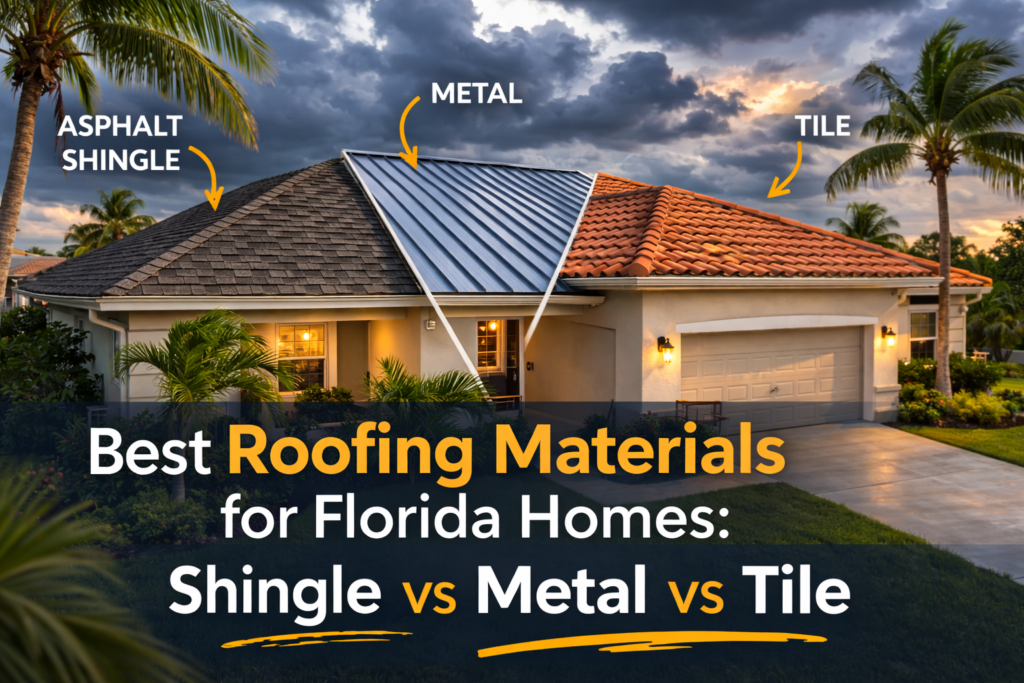
Choosing the right roofing material for a Florida home is one of the most important decisions a Tampa homeowner can make. Get it right and your roof will protect your home through decades of heat, humidity, and hurricane seasons. Get it wrong and you are looking at premature failure, expensive repairs, and potential insurance headaches.
The three materials that dominate Tampa roofing are asphalt shingles, metal roofing, and concrete or clay tile. Each has real advantages and real tradeoffs in Florida’s specific climate. This guide breaks down exactly how each one performs so you can make the right call for your home, your budget, and your long-term plans.
If you want an honest assessment of which material makes the most sense for your specific home, Tampa Premier Roofing offers free roof inspections and consultations with no obligation and no pressure.
Why Roofing Material Choice Matters More in Florida Than Anywhere Else
Most roofing materials are tested and rated for average North American conditions. Florida — and Tampa specifically — is not average. Your roof faces all of the following every single year:
- UV radiation intense enough to degrade asphalt shingles years faster than in northern states
- Roof surface temperatures regularly exceeding 160–180 degrees Fahrenheit in summer
- Humidity that promotes mold, algae, and moisture infiltration
- Hurricane-force winds during storm season — Tampa sits in one of Florida’s most active hurricane corridors
- Heavy rainfall averaging over 46 inches per year, often falling in concentrated afternoon storms
A roofing material that performs well in Ohio or Colorado may underperform significantly in Tampa. Understanding how each material handles these specific conditions is the starting point for making a smart choice.
Asphalt Shingles in Florida
Overview
Asphalt shingles are the most common roofing material in Tampa and across the United States. They come in two main varieties: three-tab shingles, which are thinner and less expensive, and architectural (dimensional) shingles, which are thicker, more durable, and now the standard for new installations in Florida.
How Long They Last in Florida
Nationally, architectural shingles carry 30-year warranties. In Florida’s climate, realistic lifespan is 18–22 years for high-quality architectural shingles and 12–17 years for three-tab shingles. The intense UV exposure and heat are the primary culprits — they break down the asphalt oils and cause shingles to dry out, crack, and lose their protective granule coating significantly faster than in cooler climates.
Florida Building Code Requirements
Florida’s high-velocity hurricane zone building code now requires impact-resistant shingles rated for high wind speeds in most Tampa-area installations. These shingles carry better wind warranties — typically 130 mph or higher — and perform meaningfully better in storm conditions than standard architectural shingles. If you are replacing a roof in Tampa, your contractor should be installing code-compliant impact-resistant shingles as a baseline.
Cost
Asphalt shingles are the most affordable roofing option for Tampa homes. A typical full replacement on a 2,000 square foot home runs approximately $8,000–$14,000 depending on roof complexity, material grade, and current labor costs. Impact-resistant shingles add a moderate premium over standard architectural shingles but are required by code and can qualify you for insurance discounts that offset the difference over time.
Pros of Asphalt Shingles for Florida Homes
- Lowest upfront cost of any major roofing material
- Widely available — easy to source materials and find qualified contractors
- Fast installation — most Tampa homes can be fully re-roofed in one day
- Repairs are straightforward and inexpensive
- Impact-resistant versions qualify for Florida homeowners insurance discounts
Cons of Asphalt Shingles for Florida Homes
- Shorter lifespan than metal or tile in Florida’s climate
- Prone to algae staining — black streaks are common on Tampa roofs within a few years
- Granule loss accelerates in intense Florida heat, aging the roof faster
- Not the strongest wind resistance option — even impact-rated shingles have limits
- Lower home resale value compared to metal or tile
Best For
Asphalt shingles are the right choice for Tampa homeowners with budget constraints, those planning to sell within 10 years, or those replacing a roof on an older home where the long-term investment math favors lower upfront cost over maximum longevity.
Metal Roofing in Florida
Overview
Metal roofing has become increasingly popular in Tampa over the past decade, and for good reason — it is arguably the best-performing roofing material for Florida’s specific climate. Standing seam metal roofing, where the panels interlock and fasteners are hidden beneath the surface, is the gold standard for residential metal roofing in Florida.
How Long It Lasts in Florida
A properly installed standing seam metal roof in Tampa will realistically last 40–70 years. Metal is non-porous so it does not absorb moisture or support algae growth. It reflects rather than absorbs UV radiation so it does not degrade the way asphalt does. It expands and contracts with temperature changes without cracking. In Florida’s climate, metal roofing simply outlasts every alternative by a wide margin.
Hurricane Performance
Metal roofing offers the best wind resistance of any common residential roofing material. Properly installed standing seam metal roofs are rated for winds of 140–160 mph or higher, exceeding the requirements for even Florida’s most demanding hurricane zones. The interlocking panel design eliminates the individual fastener vulnerabilities that cause shingles and tiles to fail in high winds.
Energy Efficiency
Metal roofs reflect solar heat rather than absorbing it, which can reduce cooling costs by 10–25% in Tampa’s hot climate. This energy savings compounds over time and contributes to the overall financial case for metal roofing even at its higher upfront cost.
Cost
Standing seam metal roofing is a significant investment — typically $18,000–$35,000 for a full replacement on a Tampa home depending on roof size and complexity. That is roughly 2–3 times the cost of architectural shingles. However, when you factor in the 40–70 year lifespan, lower maintenance costs, energy savings, potential insurance premium reductions, and increased home value, the long-term financial case for metal roofing is strong for homeowners planning to stay in their home.
Pros of Metal Roofing for Florida Homes
- Longest lifespan of any common roofing material in Florida — 40 to 70 years
- Best hurricane wind resistance — rated 140 mph or higher when properly installed
- No algae, mold, or rot — completely non-porous surface
- Significant energy savings from solar heat reflection
- Low maintenance — no granule loss, no cracking, no periodic treatment needed
- Can qualify for major homeowners insurance discounts in Florida
- Increases home resale value
Cons of Metal Roofing for Florida Homes
- Highest upfront cost — typically 2 to 3 times more than asphalt shingles
- Requires a specialized contractor — not every Tampa roofer has standing seam experience
- Can be louder during heavy rain — though proper insulation and underlayment minimize this
- Denting from large hail is possible, though Tampa rarely sees large hail
- Longer installation time than shingles — typically 2 to 3 days
Best For
Metal roofing is the best long-term investment for Tampa homeowners who plan to stay in their home for 10 or more years, want maximum hurricane protection, and are willing to pay more upfront to avoid replacement costs for decades.
Concrete and Clay Tile Roofing in Florida
Overview
Tile roofing is extremely common in Tampa and throughout South Florida — so common that many homeowners assume it is the default. Concrete tile and clay tile are both widely used. Clay tile is the original material, offers a distinctive warm appearance, and is more expensive. Concrete tile is less expensive, heavier, and the more common choice for most Tampa residential installations.
How Long It Lasts in Florida
The tile material itself handles Florida’s climate extremely well. Properly maintained concrete or clay tile can last 30–50 years in Tampa. The tiles do not degrade from UV exposure the way asphalt does. They do not rust like metal can if improperly installed. They are non-combustible and pest-resistant.
The important caveat: the underlayment beneath the tile — the actual waterproofing layer — typically needs replacement every 20–30 years even when the tiles themselves are in excellent condition. A tile roof that looks perfect from the street may have a failing underlayment allowing water infiltration into the attic and ceiling. This is the most misunderstood aspect of tile roof maintenance in Tampa.
Hurricane Performance
Tile roofing has a mixed performance record in Florida hurricanes. Individual tiles are heavy and resist wind well when properly attached. However, when tiles do become airborne they become dangerous projectiles, and the interlocking attachment systems on older tile roofs — especially those installed before Florida’s post-Hurricane Andrew building code reforms — are significantly less wind-resistant than modern installation methods.
Modern tile roofing installed to current Florida building code, with proper mechanical fastening rather than relying solely on adhesive, performs well in hurricane conditions. Older tile roofs may need a fastening assessment before hurricane season.
Weight Considerations
Concrete tile is heavy — typically 9–12 pounds per square foot compared to 2–4 pounds for asphalt shingles. Not every home is structurally designed to support a tile roof without reinforcement. If you are considering switching from shingles to tile, a structural assessment is essential before installation begins.
Cost
Concrete tile roofing typically costs $12,000–$22,000 for a full replacement on a Tampa home. Clay tile runs $18,000–$30,000 or more. Both sit between asphalt shingles and premium metal roofing in terms of upfront cost, though the periodic underlayment replacement adds a significant long-term maintenance cost that shingles and metal do not have in the same way.
Pros of Tile Roofing for Florida Homes
- Excellent aesthetic — the standard look for Mediterranean and Spanish-style Tampa homes
- Long tile lifespan — 30 to 50 years with proper underlayment maintenance
- Good UV and heat resistance — the tile material itself does not degrade quickly
- Non-combustible — important for Florida’s dry season
- Strong home resale value — tile roofs are expected on many Tampa-area home styles
Cons of Tile Roofing for Florida Homes
- Underlayment requires replacement every 20 to 30 years — significant additional cost
- Heavy — structural assessment required before installation on some homes
- Individual tiles crack from impact — hail, falling branches, or foot traffic can damage tiles
- Higher cost than shingles
- Not all contractors are experienced with proper tile installation to current Florida code
Best For
Tile roofing is the right choice for Tampa homeowners with Mediterranean, Spanish, or Florida-style architecture where tile is the expected aesthetic, and for those who understand the underlayment maintenance requirement and factor it into their long-term cost planning.
Side-by-Side Comparison for Tampa Homeowners
Here is a quick reference for how the three materials compare on the factors that matter most in Florida:
- Lifespan in Florida: Asphalt 18–22 years | Metal 40–70 years | Tile 30–50 years (underlayment 20–30 years)
- Upfront cost (2,000 sq ft home): Asphalt $8,000–$14,000 | Metal $18,000–$35,000 | Tile $12,000–$22,000
- Hurricane wind resistance: Asphalt Good | Metal Excellent | Tile Good (modern install)
- Algae/mold resistance: Asphalt Low | Metal Excellent | Tile Good
- Energy efficiency: Asphalt Average | Metal Excellent | Tile Good
- Maintenance: Asphalt Low | Metal Very Low | Tile Moderate (underlayment)
- Insurance discount potential: Asphalt Yes (impact-rated) | Metal Yes (significant) | Tile Moderate
Which Roofing Material Is Right for Your Tampa Home?
The honest answer depends on your specific situation:
Choose asphalt shingles if you need to replace your roof on a budget, plan to sell within 10 years, or are replacing a roof on an older home where the long-term investment math does not favor a premium material.
Choose metal roofing if you plan to stay in your home long term, want maximum hurricane protection, and can absorb the higher upfront cost in exchange for decades of near-zero maintenance and the best lifespan in Florida’s climate.
Choose tile if your home has Mediterranean or Spanish architecture where tile is the expected look, and you are prepared to budget for underlayment replacement every 20–30 years in addition to the upfront installation cost.
The best way to get a recommendation tailored to your specific home, budget, and goals is to start with a free inspection. Tampa Premier Roofing assesses your current roof, walks you through all three options honestly, and helps you make the right call — no pressure, no obligation.
Frequently Asked Questions
Q: What is the best roofing material for hurricane protection in Tampa?
Standing seam metal roofing offers the best hurricane wind resistance of any common residential roofing material, with properly installed systems rated for 140–160 mph or higher. Impact-resistant architectural shingles are a strong second choice at a lower price point. Modern tile installed to current Florida building code also performs well, though older tile roofs with adhesive-only fastening are more vulnerable.
Q: Is metal roofing worth the extra cost in Florida?
For homeowners planning to stay in their home 10 or more years, metal roofing typically is worth the premium. The 40–70 year lifespan means you avoid 1–2 full roof replacements over the same period, energy savings of 10–25% on cooling costs compound over time, and Florida insurance carriers often offer significant premium discounts for metal roofs. The upfront cost is higher but the long-term total cost of ownership is often lower than asphalt shingles.
Q: How do I know if my tile roof needs a new underlayment?
The tiles themselves often look fine even when the underlayment is failing. Signs to watch for include water stains on interior ceilings, dark staining visible at the roof eaves, or a musty smell in the attic. If your tile roof is more than 20 years old, have the underlayment specifically inspected even if the tiles look perfect from the ground. Tampa Premier Roofing offers free inspections that include underlayment assessment.
Q: Do asphalt shingles void my Florida homeowners insurance?
Asphalt shingles themselves do not void insurance, but the age and condition of your roof increasingly affects coverage in Florida’s market. Many carriers now offer ACV-only coverage for roofs over 10–15 years old, and some will non-renew policies on older shingle roofs entirely. Impact-resistant shingles rated for high-velocity hurricane zones can actually qualify you for insurance discounts and make your home easier to insure.
Q: Can I switch from shingles to tile or metal on my Tampa home?
Yes, but with important considerations. Switching from shingles to concrete or clay tile requires a structural assessment first — tile is significantly heavier and not all homes are built to support it without reinforcement. Switching to metal roofing is generally straightforward from a structural standpoint. Both switches require permits in Tampa. A licensed contractor can walk you through what your specific home needs.
Q: What roofing material is best for resale value in Tampa?
Metal roofing and tile both add strong resale value in the Tampa market, though in different ways. Metal roofing is valued for its longevity and hurricane resistance — buyers understand they are unlikely to face a roof replacement for decades. Tile is valued for its aesthetics on Mediterranean and Spanish-style homes where it is the expected material. Asphalt shingles add less premium to resale value but a recently installed shingle roof is still a positive selling point compared to an aging one.
Q: How long does a roof replacement take in Tampa?
Most asphalt shingle replacements on Tampa homes are completed in a single day. Metal roofing typically takes 2–3 days due to the more precise installation process. Tile roofing generally takes 3–5 days depending on roof complexity. Weather, roof size, and accessibility all affect timing. Permits are required for all full roof replacements in Tampa and must be pulled before work begins — a reputable contractor handles this automatically.