

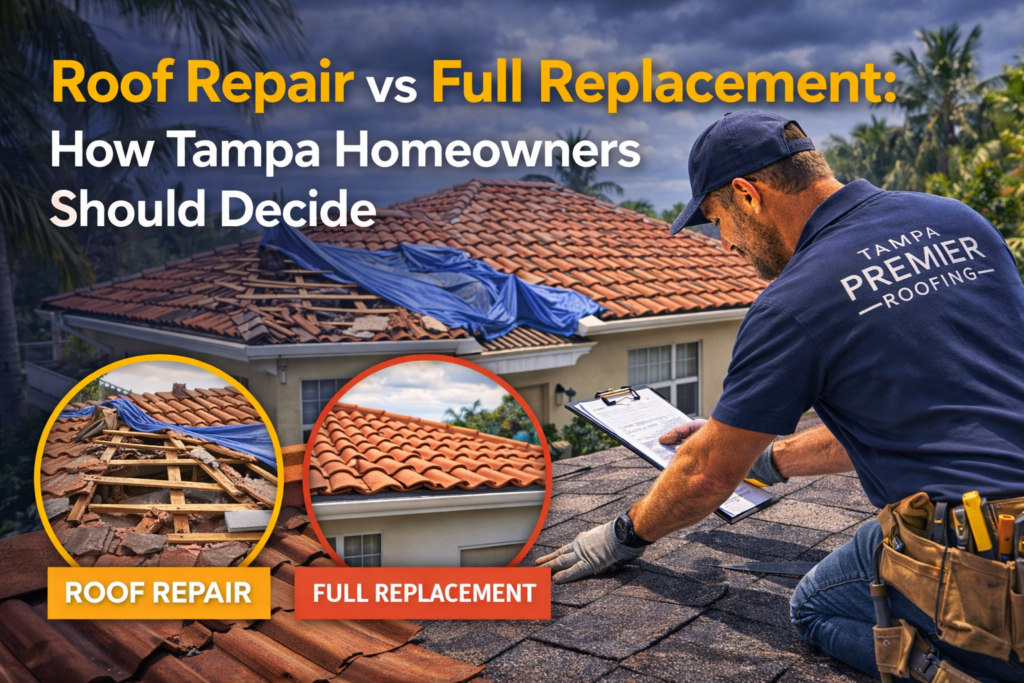
When a Tampa homeowner discovers a roof problem — a leak after a storm, missing shingles, a water stain on the ceiling — the first question is almost always the same: do I need to repair this or replace the whole roof?
It is one of the most important financial decisions a homeowner can make, and the right answer depends on factors that are impossible to evaluate without actually getting on the roof. This guide breaks down exactly how to think through the repair vs. replacement decision, what factors push the decision in each direction, and how Florida’s specific climate and insurance market affect the calculus in ways that do not apply in other states.
If you want an honest, no-pressure assessment of your specific roof, Tampa Premier Roofing offers free inspections with full photo documentation — we will tell you exactly what we find and give you a straight answer on whether repair or replacement makes more sense for your situation.
The Core Question: Is This an Isolated Problem or a System Failure?
The repair vs. replacement decision comes down to one fundamental question: is the damage you are seeing an isolated issue with an otherwise sound roof, or is it a symptom of a roof that has reached the end of its useful life?
A roof is a system — shingles, underlayment, decking, flashing, ventilation, and fasteners all working together. When one component fails in isolation — a few shingles blown off in a storm, a single flashing seal that has cracked — repair is the right answer. When the system itself is failing — shingles losing granules across the entire surface, underlayment deteriorating, multiple leak points developing — repair is like putting a bandage on a problem that requires surgery.
The challenge is that the difference between an isolated problem and a system failure is usually not visible from the ground — and is sometimes not obvious even from on the roof without a thorough inspection. This is why a professional assessment matters so much before committing to either path.
Factors That Point Toward Repair
The Roof Is Less Than 10 Years Old
A Tampa roof that is less than 10 years old and has been properly maintained has significant useful life remaining. Storm damage, isolated leaks, or flashing failures on a young roof are almost always repair situations — the underlying system is sound and repairing the specific damage point makes clear financial sense.
Damage Is Clearly Localized
If damage is limited to a specific area — one section of shingles after a fallen branch, a single flashing failure around a chimney, a small area of wind damage on one slope — and the rest of the roof is in good condition, repair is the appropriate response. The key word is confirmed. ‘The rest of the roof looks fine from the ground’ is not the same as ‘the rest of the roof has been inspected and confirmed to be in good condition.’
The Repair Cost Is Less Than 25–30% of Replacement Cost
A common rule of thumb: if the cost of repair is less than 25–30% of what a full replacement would cost, repair is generally the better financial decision — provided the rest of the roof is in solid condition. If you are spending more than that on a repair and the roof is aging, you may be investing money in a system that will need full replacement in a few years anyway.
Insurance Is Covering the Damage
When storm damage is covered by homeowners insurance, the repair vs. replacement decision changes. If insurance is covering the cost of a repair to a damaged section of a roof that is otherwise in good condition, accepting that repair makes sense. If insurance is covering a full replacement because the storm damage is extensive — or because the adjuster and your contractor agree the roof has reached the end of its life — take the replacement.
Factors That Point Toward Replacement
The Roof Is Approaching or Past Its Expected Lifespan
This is the single biggest factor in the Tampa market. If your asphalt shingle roof is 15 or more years old, every repair dollar you spend is buying time on a system that is approaching end of life. Florida’s climate means asphalt shingles realistically last 18–22 years — not the 30 years advertised on the package. A 17-year-old roof that needs $3,000 in repairs is a roof that may need $12,000 in full replacement in 3–4 years. The math often favors replacement.
Multiple Leak Points or Widespread Damage
If a thorough inspection reveals multiple areas of damage — not one problem but three or four — that is a system failure, not an isolated issue. Repairing one section while leaving others in deteriorating condition means you will be back on the roof — and spending more money — within months. Widespread damage is a strong signal that the system has reached the end of its reliable life.
Significant Granule Loss Across the Roof
Granule loss is one of the clearest indicators of a shingle roof nearing end of life in Florida. Asphalt shingles depend on their granule coating for UV protection and water resistance. When those granules are gone — visible as bare, dark patches on the shingles or heavy granule accumulation in gutters — the underlying asphalt is exposed and degrading rapidly. This is a roof-wide condition that repair cannot fix.
Decking Damage or Rot
If a roof inspection reveals damage to the underlying decking — soft spots, rot, or structural compromise — the cost and scope of repair escalates dramatically. Replacing decking requires removing roofing material, making the incremental cost difference between a major repair and a full replacement much smaller. In many cases, decking damage makes full replacement the financially sensible choice.
Your Insurance Company Is Pressuring You to Replace
Florida insurance carriers are increasingly scrutinizing older roofs. If your carrier has flagged your roof for age or condition and is requiring replacement as a condition of continued coverage — or if you are finding it difficult to insure the home because of the roof’s age — that is a market signal that repair is not a long-term solution. Replacing now on your terms, with a contractor you choose, is better than being forced to replace under carrier pressure later.
You Plan to Sell the Home Within 5 Years
A buyer’s inspector will flag an aging roof. A Tampa home with a 16-year-old shingle roof will either sit on the market longer, attract lower offers, or require a price concession that exceeds the cost of proactive replacement. If you are planning to sell, a new roof is one of the highest-ROI improvements you can make to a Tampa home — it removes a major buyer objection and can qualify the property for better insurance rates for the new owner.
The Florida-Specific Factors That Make This Decision Different
Insurance Coverage and Roof Age
Florida’s insurance market has fundamentally changed how the repair vs. replacement decision works for Tampa homeowners. Many carriers now offer only ACV (actual cash value) coverage — which pays the depreciated value of your roof, not replacement cost — for roofs over a certain age, typically 10–15 years. Some carriers will not insure homes with roofs over 15–20 years old at all.
This means repairing a 14-year-old roof may preserve your current coverage for now but put you on a clock — in one to two years, that same roof may become uninsurable or only coverable at ACV, meaning the next storm damage claim pays you a fraction of actual replacement cost. Understanding how your roof’s age interacts with your coverage is an essential part of the repair vs. replacement decision in Tampa.
Hurricane Season Timing
Tampa’s hurricane season runs June 1 through November 30. A roof that needs repair or is marginal going into hurricane season is a genuine liability. An aging roof that makes it through one more storm season may not make it through the next. Many Tampa homeowners who choose to repair an aging roof in spring find themselves facing emergency replacement — at higher cost, on tighter timelines — after a summer storm.
Proactive replacement before hurricane season, with proper permits and time to inspect and approve the work, is almost always less expensive and less stressful than reactive emergency replacement after storm damage.
Florida’s Post-Storm Insurance Market
After a major Tampa storm, roofing contractors are in high demand and timelines extend significantly. Emergency replacements after widespread storm events cost more than proactively scheduled replacements — both because of demand and because temporary repairs add cost before the permanent work can begin. Homeowners who replace proactively before a storm hit control their timeline, their contractor choice, and their cost.
The 50% Rule: A Useful Tampa Framework
A practical framework many Tampa roofing professionals use: if the cost of repairing the damage exceeds 50% of the cost of a full replacement, replace the roof. At that spending level, you are making a significant investment in a system of uncertain remaining life — and a full replacement gives you a known, warranted system with a predictable lifespan instead.
This rule is a guideline, not a formula. A 12-year-old roof that needs a repair costing 55% of replacement may still be better served by repair. A 19-year-old roof that needs a repair costing 30% of replacement may still warrant replacement given its age and Florida’s climate. The framework is a starting point for the conversation, not the end of it.
What to Do Before Making the Decision
Before committing to either repair or replacement, take these steps:
- Get a professional inspection from a licensed Tampa roofing contractor — not just a visual assessment from the ground
- Ask for a written inspection report with photos documenting the condition of the entire roof system, not just the visible damage
- Get the inspector’s honest assessment of remaining useful life — not just what needs to be fixed today
- If you have homeowners insurance, understand your coverage type (ACV vs RCV) and how your roof’s age affects your claim potential before deciding
- Get quotes for both repair and replacement so you can compare the actual numbers, not estimates
- Factor in hurricane season timing — if you are within a few months of June, the calculus on marginal roofs shifts toward replacement
At Tampa Premier Roofing, our free inspections include an honest assessment of your roof’s current condition, remaining lifespan, and a straight answer on whether repair or replacement makes more financial sense for your specific situation. We do not push replacements when repairs are the right call — and we do not recommend repairs when replacement is clearly the better decision.
Schedule your free Tampa roof inspection here — we serve Tampa, Brandon, Riverview, and surrounding areas.
Frequently Asked Questions
Q: How do I know if my Tampa roof needs repair or replacement?
The only reliable way to know is a professional inspection. Age is the most important factor — if your asphalt shingle roof is 15 or more years old in Florida’s climate, replacement is often the better financial decision even for seemingly minor damage. Multiple leak points, widespread granule loss, and decking damage are the clearest signals that replacement is the right call. Tampa Premier Roofing offers free inspections with honest assessments at no obligation.
Q: Is it worth repairing a 15-year-old roof in Tampa?
It depends on the scope of the repair and the overall condition of the roof. A minor repair on a 15-year-old roof that is otherwise in solid condition may make sense. However, Florida’s climate means 15-year-old asphalt shingles are in the later stages of their realistic lifespan — not the middle. If the repair is significant, or if the rest of the roof shows signs of age-related deterioration, replacement is often the better long-term investment.
Q: Can I just repair the section of roof that is leaking?
Yes, if the leak is truly isolated and the rest of the roof is in good condition. The risk is assuming the leak is isolated without confirming it through a full inspection. Many Tampa homeowners repair one visible leak point and discover a second — or third — shortly after. A professional inspection before any repair work tells you whether you are dealing with an isolated problem or a pattern.
Q: Will my insurance pay for a full roof replacement in Tampa?
It depends on your policy type and the cause of damage. If storm damage is extensive enough that your carrier’s adjuster agrees a full replacement is warranted, and you have RCV (replacement cost value) coverage, your insurance should cover the replacement minus your deductible. If you have ACV coverage and an older roof, the payout may cover only a fraction of the actual replacement cost. Understanding your coverage before a storm is important.
Q: How much does a roof repair typically cost in Tampa?
Minor repairs — replacing a few shingles, resealing flashing, repairing a pipe boot — typically cost $300–$800 in Tampa. Moderate repairs involving a section of shingles, flashing replacement, or partial decking repair run $800–$3,500. Larger repairs approaching 25% of the roof surface can cost $3,500–$6,000 or more. At that level, comparing the repair cost against a full replacement quote is essential before committing.
Q: How long will a roof repair last in Tampa’s climate?
A well-executed repair on a structurally sound roof can last as long as the surrounding roofing material — potentially 5 to 10 years or more. A repair on an aging roof with widespread granule loss or deteriorating underlayment may only buy 1 to 3 years before the next problem develops. The longevity of a repair depends almost entirely on the condition of the surrounding roof system, which is why a full inspection before committing to repair matters so much.
Q: Is a new roof a good investment before selling a Tampa home?
Generally yes. A new roof removes one of the most common buyer objections and home inspection red flags in the Tampa market. Buyers know that an aging or damaged roof means either a price negotiation or an immediate post-purchase expense. A new roof simplifies the sale, can qualify the home for better insurance rates for the buyer, and typically returns a significant portion of its cost in sale price. For homes with roofs over 15 years old, replacement before listing is often the highest-ROI pre-sale improvement available.