

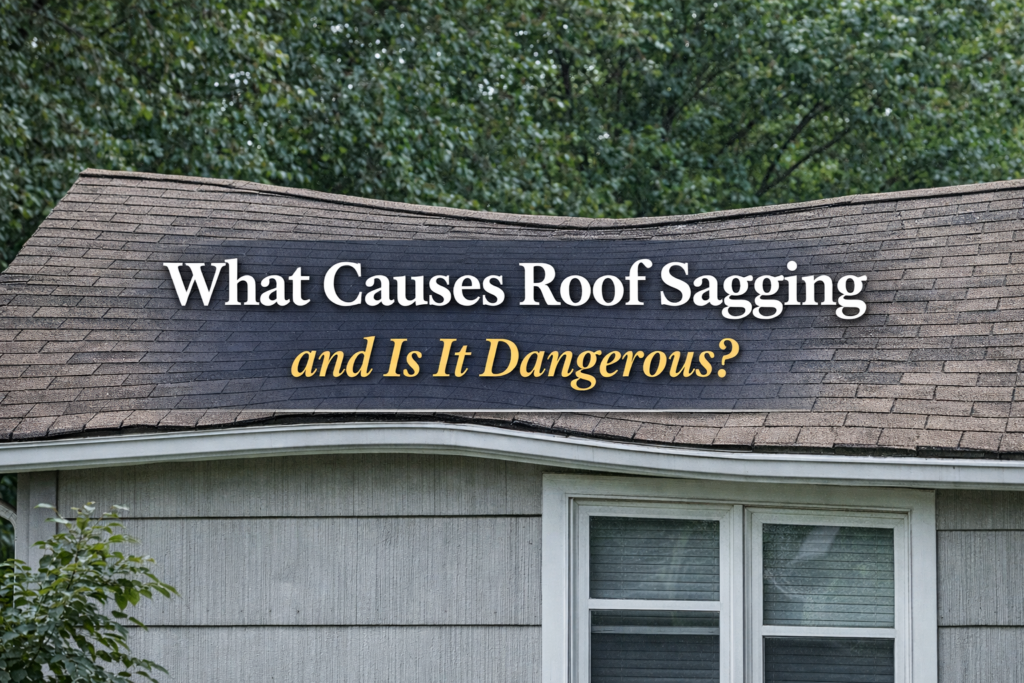
If you’ve noticed a dip, a curve, or a wavy appearance in your roofline, your first instinct is probably concern — and rightfully so. A sagging roof is one of those problems that homeowners sometimes dismiss as a cosmetic issue, only to discover later that it was a warning sign of something far more serious happening to their home’s structure.
The truth is, a sagging roof is never just a visual problem. It always means something is wrong — whether that’s deteriorating materials, structural damage, water infiltration, or a combination of all three. And in Florida’s demanding climate, where intense heat, humidity, and hurricane-force winds put roofs under constant stress, a sagging roof can deteriorate from a manageable repair into a full structural emergency faster than in almost any other state.
At Tampa Premier Roofing, we inspect sagging roofs across Tampa Bay on a regular basis. Some of what we find is fixable with targeted repairs. Some of it requires a full roof replacement. And occasionally, we find situations that require immediate structural intervention before anything else can be done.
In this comprehensive guide, we’re going to walk you through everything you need to know about roof sagging — what causes it, what it looks like, how dangerous it really is, what it costs to fix, and most importantly, what you should do if you notice it on your home.
What Does a Sagging Roof Actually Look Like?
Before we dive into causes and solutions, it’s worth making sure we’re talking about the same thing. Roof sagging can appear in several different ways, and the location and pattern of the sag can actually tell an experienced contractor a lot about what’s causing it.
Types of Roof Sagging
- Ridge sagging — The horizontal ridge line at the very top of a pitched roof dips in the middle or along a section. This often indicates problems with the ridge board, the rafters, or the structural supports beneath.
- Deck sagging — The roof surface between rafters or trusses appears to dip or wave. This is often a sign of deteriorated or waterlogged roof decking (the plywood or OSB beneath the shingles).
- Rafter sagging — Individual rafters have bent or broken, causing uneven dips across the roof surface. This can result from overloading, water damage to the wood, or insect damage.
- Widespread or whole-roof sagging — The entire roof surface appears to be settling or drooping. This is the most serious type and often indicates significant structural problems with the walls, foundation, or primary support system.
- Soffit and fascia sagging — The horizontal boards under the roof overhang are drooping or pulling away. This often indicates water damage to the fascia and rafter tails.
Each of these patterns points to different underlying causes, which is why a professional inspection is so important when you notice any kind of irregularity in your roofline.
How to Spot Roof Sagging From the Ground
You don’t need to climb on your roof to notice sagging — in fact, we strongly recommend against homeowners going on their roofs without proper training and equipment. Here’s how to evaluate your roofline safely from the ground:
- Stand at the corner of your home and look along the ridge line — it should be perfectly straight and level. Any dip or curve is a red flag.
- Step back far enough to see the entire roof slope — the surface should appear flat and even. Waves, dips, or uneven sections indicate deck or rafter problems.
- Look at the eaves — the line where the roof meets the top of the exterior walls should be straight and consistent. A wavy or uneven eave line suggests structural issues.
- Check the gutters — if gutters are pulling away from the fascia or sagging in sections, that can indicate the fascia and rafter tails behind them are damaged.
If you notice any of these signs, the next step is to call a licensed roofing contractor for a professional inspection — not to wait and see if it gets worse.
The Most Common Causes of Roof Sagging
Roof sagging doesn’t happen overnight in most cases. It’s typically the result of one or more underlying problems that have been developing over time. Here are the most common causes we see on Tampa Bay homes:
1. Water Damage and Rot
Water damage is far and away the most common cause of roof sagging in Florida. Our climate — with its intense rainy season, high humidity, and frequent storm events — creates constant opportunities for water to infiltrate roofing systems. When it does, the consequences for wooden structural components can be severe.
Wood that is repeatedly exposed to moisture loses its structural integrity over time. Rafters, trusses, and roof decking that have absorbed water will swell, warp, and eventually begin to rot. Rotted wood cannot support the weight of roofing materials, and over time it deflects and sags under the load.
The insidious thing about water damage in a roof structure is that it often isn’t visible from inside the living space until it’s quite advanced. By the time a homeowner notices water stains on their ceiling or sagging drywall, the damage to the wooden structure above may have been building for months or even years.
Common entry points for water that leads to structural rot include:
- Failed or deteriorated flashings around chimneys, skylights, and vents
- Cracked, missing, or lifted shingles or tiles
- Deteriorated pipe boot seals around plumbing vents
- Ice dams — less common in Florida but can occur during unusual cold snaps
- Clogged gutters that cause water to back up under the roof edge
- Failed valley flashing where two roof slopes meet
2. Age-Related Deterioration
Every roofing system has a finite lifespan, and the structural components beneath the roofing materials age along with the surface materials — sometimes faster, depending on conditions. In Florida’s climate, the accelerated deterioration caused by UV radiation, heat cycling, and humidity means that roof structures can age faster than in cooler, drier climates.
As wooden rafters and trusses age, even without direct water exposure, they can gradually lose some of their stiffness and load-bearing capacity. This is especially true in older homes built with lumber that may not meet modern standards for structural timber. Over decades, the cumulative effect of gravity, thermal cycling, and the weight of roofing materials can cause gradual deflection in aging structural members.
If your home is more than 30–40 years old and you’ve never had a structural roof inspection, it’s worth having one done — particularly before hurricane season, when your roof will be put to the ultimate test.
3. Improper Original Construction
Not all roof sagging is the result of deterioration — some of it stems from problems that existed from the day the roof was built. Improper original construction is more common than many homeowners realize, particularly in homes built during periods of rapid construction or by contractors cutting corners.
Construction-related causes of roof sagging include:
- Undersized rafters or trusses that were not engineered to carry the actual load of the roofing materials installed
- Insufficient rafter or truss spacing — standard spacing is typically 16 or 24 inches on center, and wider spacing without appropriate sizing adjustments can lead to deflection
- Missing or inadequate collar ties and ridge boards that are necessary to prevent rafters from spreading outward under load
- Poor quality lumber used in the original construction that had defects, knots, or was already partially compromised when installed
- Incorrect installation of engineered trusses — trusses must be installed exactly as designed; modifications or incorrect bracing can dramatically reduce their load capacity
4. Overloading
Every roof is engineered to carry a specific load — a combination of the dead load (the weight of the roofing materials themselves) and the live load (wind, rain, and in northern states, snow). When a roof is overloaded beyond its design capacity, sagging is the inevitable result.
In Florida, overloading most commonly occurs when:
- A heavy roofing material like concrete or clay tile is installed over a structure that was originally designed for lighter asphalt shingles, without upgrading the structural support
- Multiple layers of roofing materials are installed on top of each other — for example, a second layer of shingles over the original layer — adding significant weight that the structure wasn’t designed for
- Rooftop equipment like HVAC units, solar panel systems, or water tanks are added without a structural assessment to confirm the roof can handle the additional load
- Waterlogged roofing materials after a major storm event — saturated insulation and decking can temporarily add enormous weight to a roof structure
5. Termite and Pest Damage
Florida is one of the most termite-active states in the country. Subterranean termites, drywood termites, and Formosan termites are all present in Tampa Bay, and wooden roof structures are among their preferred targets. A termite infestation in roof rafters or trusses can hollow out structural members from the inside, leaving them looking intact on the surface while being almost completely compromised internally.
By the time visible sagging appears from termite damage, the infestation has typically been active for years and the structural damage is often extensive. This is why regular termite inspections — not just roof inspections — are so important for Florida homeowners. Catching an infestation early, before it reaches the structural roof components, can prevent an expensive roofing problem from becoming a catastrophic structural one.
Other wood-destroying organisms that can contribute to roof structural damage in Florida include wood-boring beetles and carpenter ants, though these are generally less destructive than termites.
6. Foundation or Wall Movement
Sometimes what looks like a roof problem is actually a symptom of something happening lower in the structure. Foundation settling, wall movement, or framing issues can all manifest as apparent roof sagging — even when the roof structure itself is in reasonably good condition.
In Florida, foundation movement can be caused by:
- Soil settlement — particularly in areas built on fill soil, which is common throughout Tampa Bay
- Sinkhole activity — Florida’s limestone bedrock makes sinkhole formation a real concern in many parts of the state
- Moisture changes in expansive soils — periods of drought followed by heavy rain can cause soils to expand and contract, stressing foundations
- Poor original foundation construction
If roof sagging appears to be related to foundation or wall movement, a structural engineer — not just a roofing contractor — should be involved in the assessment. Fixing the roof without addressing the underlying structural issue will only result in the problem recurring.
Is a Sagging Roof Dangerous? Understanding the Real Risks
This is the question every homeowner wants answered when they notice their roof sagging. The honest answer is: it depends on the cause, the extent, and how long it has been developing. But in almost every case, a sagging roof represents a real risk that should be taken seriously.
The Risk of Collapse
In severe cases — particularly where sagging is caused by extensive structural damage, rot, or termite destruction — a roof can collapse. While total roof collapse is relatively rare, partial collapse is more common than most people realize. A section of roof decking giving way, a rafter snapping under load, or a truss failing can cause serious damage to the interior of a home and pose a genuine safety risk to anyone inside.
The risk of collapse increases dramatically during high-wind events. A roof structure that is already compromised by rot, pest damage, or structural deficiencies is far more likely to fail under hurricane-force winds than a sound roof. This is particularly relevant for Tampa Bay homeowners heading into hurricane season.
The Risk of Accelerating Water Damage
A sagging roof almost always has compromised roofing materials above the sagging area. Shingles and tiles that are no longer lying flat are far more vulnerable to water infiltration — especially during wind-driven rain. This means that a sagging roof tends to get worse faster during Florida’s rainy season, as each rain event introduces more water into an already compromised structure.
Once water begins regularly entering the structure, the cycle of damage accelerates rapidly. Wet wood rots faster, which causes more sagging, which allows more water in, which causes more rot. Left unaddressed, what might start as a manageable repair can become a full structural replacement in a matter of seasons.
The Risk to Home Value and Insurability
From a financial standpoint, a sagging roof is one of the most damaging things a home can have when it comes to value and insurability. Home inspectors will flag it immediately, making it nearly impossible to sell a home without addressing it first. And Florida insurance carriers — already skittish about roof risk — may refuse to insure or renew coverage on a home with visible roof sagging.
How Is a Sagging Roof Diagnosed and Repaired?
The right repair approach for a sagging roof depends entirely on what’s causing it. This is why diagnosis always comes before repair — and why the diagnosis needs to be done by someone who knows what they’re looking at.
The Inspection Process
A thorough inspection of a sagging roof involves both an exterior assessment and an attic inspection. From the exterior, the contractor will evaluate the roofline, the condition of the roofing materials, and the overall shape and geometry of the roof. From the attic, they’ll assess the condition of the rafters or trusses, the decking, the insulation, and look for signs of water damage, pest activity, or structural deficiencies.
In cases where foundation or wall movement is suspected, or where the structural damage is extensive, a licensed structural engineer may need to be brought in to provide a formal assessment and repair specifications.
Repair Options for Sagging Roofs
Depending on what the inspection reveals, repair options can range from relatively straightforward to quite involved:
- Deck replacement — If the sagging is limited to deteriorated roof decking between otherwise sound rafters, the damaged decking sections can be removed and replaced. This is one of the more common and manageable repairs.
- Rafter sistering — When individual rafters are damaged or rotted but the overall structure is sound, a technique called sistering involves attaching new lumber alongside the damaged rafter to restore structural integrity. This is a cost-effective way to reinforce compromised rafters without replacing the entire roof structure.
- Truss repair or replacement — Damaged trusses are more complex to repair than individual rafters because they are engineered systems. Truss repairs typically need to follow manufacturer or engineer specifications, and in some cases full truss replacement is the most practical option.
- Ridge board replacement — If sagging is concentrated at the ridge and caused by a failed or undersized ridge board, replacing this component can restore the roofline.
- Full structural rebuild — In cases of extensive rot, termite damage, or widespread structural failure, the most practical solution may be a complete removal of the roof structure and rebuild from scratch. This is a significant undertaking but is sometimes the only way to properly address severe structural compromise.
What Does It Cost to Fix a Sagging Roof in Tampa?
Cost is always a concern when it comes to structural roof repairs, and the range is wide depending on the extent of the damage and the repair approach required. Here’s a general breakdown of what Tampa homeowners can expect in 2026:
- Deck replacement (partial) — $500 to $2,500 depending on the area affected
- Rafter sistering (per rafter) — $200 to $500 per rafter, with most jobs involving multiple rafters
- Ridge board replacement — $1,500 to $4,000 depending on length and accessibility
- Truss repair or replacement — $2,000 to $8,000+ depending on the number of trusses affected
- Full roof structure rebuild — $15,000 to $50,000+ depending on the size of the home and extent of damage
These figures are for structural repairs only and don’t include the cost of replacing roofing materials on top. In many cases, structural repairs will require partial or complete removal and replacement of shingles, tiles, or other roofing materials, which adds to the total project cost.
The most important thing to understand about sagging roof repair costs is that they almost always increase the longer the problem is left unaddressed. What might be a $2,000 deck replacement today can become a $20,000 structural rebuild in two or three rainy seasons if the underlying water infiltration continues unchecked.
Does Homeowners Insurance Cover Sagging Roofs in Florida?
Whether insurance covers a sagging roof depends heavily on what caused the sagging and the specific language in your policy. This is an area where many Florida homeowners are surprised — often unpleasantly — when they file a claim.
Generally speaking, Florida homeowners insurance will cover sudden and accidental damage — for example, if a tree falls on your roof during a hurricane and causes structural damage that results in sagging. In these cases, the damage is sudden, clearly documented, and directly tied to a covered storm event.
What insurance typically does not cover is sagging caused by long-term deterioration, deferred maintenance, rot, or pest damage. Insurers view these as maintenance issues — the homeowner’s responsibility to prevent and address — rather than sudden covered events. If an adjuster determines that sagging was caused by years of water infiltration from a leak that should have been addressed, or by a termite infestation that went untreated, the claim is likely to be denied.
This is one more reason why regular roof inspections and prompt repairs are so important for Florida homeowners. Documented evidence of regular maintenance and timely repairs makes it much easier to demonstrate to an insurer that damage was caused by a storm event rather than neglect.
Our team at Tampa Premier Roofing can provide detailed inspection reports and documentation that support insurance claims when storm-related structural damage is the cause of roof sagging.
Preventing Roof Sagging: What Tampa Homeowners Can Do
The good news about roof sagging is that in most cases it is preventable — or at least can be caught early enough to address before it becomes a major structural problem. Here’s what proactive Tampa Bay homeowners should be doing:
Schedule Annual Roof Inspections
The single most effective thing you can do to prevent roof sagging is to have your roof professionally inspected every year. An experienced roofing contractor can identify early signs of deck deterioration, rafter damage, flashing failures, and moisture infiltration long before they develop into visible sagging. In Florida’s climate, annual inspections aren’t a luxury — they’re a necessity.
Address Leaks Immediately
Never ignore a roof leak, no matter how minor it seems. A small drip during a rainstorm might not seem urgent, but every time it rains, water is entering your roof structure and doing damage. Over months and years, even a slow leak can saturate and rot structural wood components. The moment you notice any sign of water infiltration — a stain on the ceiling, a drip during rain, moisture in the attic — call a roofing professional right away.
Keep Gutters Clean and Functional
Clogged gutters are a leading cause of water infiltration at the roof edge, which is one of the most common places for rot to begin in a roof structure. Clean your gutters at least twice a year — more often if you have large trees near your home — and make sure they’re properly attached and draining away from the house.
Maintain Your Termite Protection
Given Florida’s termite pressure, an active termite bond with a licensed pest control company is essential for any homeowner — and especially important for protecting wooden roof structures. Make sure your termite protection is current and that annual inspections are being performed. If termite activity is found anywhere in your home, treat it immediately and have your roof structure inspected for damage.
Be Mindful of Roof Loading
If you’re considering adding rooftop solar panels, a new HVAC unit, or switching from a lightweight to a heavyweight roofing material, have a structural assessment done first. Adding load to a roof that wasn’t designed to handle it is one of the most preventable causes of sagging — and one of the most commonly overlooked.
Don’t Ignore a Sagging Roof — The Sooner You Act, the Better
A sagging roof is one of those home problems that almost never gets better on its own. Left unaddressed, the underlying causes — whether water damage, structural deterioration, pest damage, or overloading — will continue to worsen with every passing season. In Florida, where rain, humidity, and hurricane winds are facts of life, a compromised roof structure is not just an expensive problem. It’s a safety risk.
If you’ve noticed any sagging, dipping, or irregularity in your roofline, the most important thing you can do right now is have it professionally inspected. Not next month, not after the rainy season — now. Early diagnosis almost always means simpler, less expensive repairs and a much better outcome than waiting until the problem has advanced.
At Tampa Premier Roofing, we specialize in diagnosing and repairing structural roof issues across Tampa Bay. Our experienced team will give you an honest, thorough assessment of your roof’s condition and walk you through your repair options clearly and without pressure.
Learn more about our team and our commitment to honest, high-quality roofing work, or explore our full range of roofing services to see how we can help. Contact us today to schedule your free roof inspection — because when it comes to a sagging roof, the best time to act is always right now.