

Published by Tampa Premier Roofing | Tampa, FL
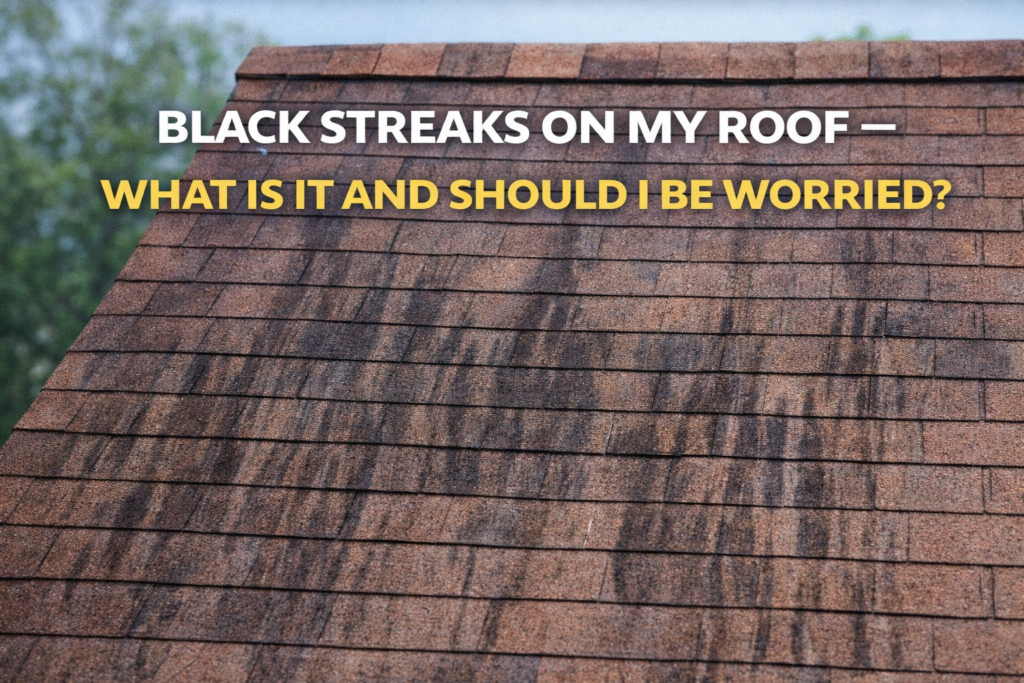
If you have noticed dark streaks running down your roof — usually starting near the top and trailing downward in irregular lines or patches — you are not alone. Black and dark gray streaking is one of the most common roof issues in Tampa and across Florida, and it generates more confused Google searches than almost any other roofing topic in the state.
The good news: those streaks are almost always algae, not structural damage. The less good news: algae is not just a cosmetic issue, and in Florida’s climate it progresses faster and causes more damage over time than most homeowners realize. Understanding what you are looking at, what it does to your roof, and how to address it correctly is worth a few minutes of reading — because the wrong response (particularly pressure washing) can cause more damage than the algae itself.
This guide covers exactly what causes roof staining in Tampa, the difference between algae, moss, mold, and lichen, what each one actually does to your roofing material, how to treat them correctly and safely, how to prevent regrowth, and when staining is a symptom of a bigger underlying problem. If you want a professional assessment of your roof’s condition alongside the staining, Tampa Premier Roofing offers free inspections with full photo documentation and no obligation.
What Is Causing the Black Streaks on Your Tampa Roof?
Gloeocapsa Magma — The Primary Culprit
The dark streaking on the vast majority of Tampa roofs is caused by a specific organism: Gloeocapsa magma, a type of blue-green algae that thrives in warm, humid climates. Tampa’s combination of heat, humidity, and abundant sunshine creates nearly ideal conditions for this organism — which is why you see it on almost every asphalt shingle roof in the area after a few years of installation.
Gloeocapsa magma feeds on the limestone filler that is used as a weight component in asphalt shingle manufacturing. The limestone is abundant, readily accessible, and provides everything the algae needs to establish and spread. As the algae colony grows, it produces a dark pigmented sheath — essentially a protective coating the organism creates around itself as a defense against UV radiation. That dark pigment is what you see as the black or dark gray streaking on your roof.
The streaking typically starts in a small area — often near the peak or along the north-facing slope where moisture stays longer — and spreads downward over time as spores are carried by wind and rainwater. In Tampa’s climate, a roof that shows minor streaking in year two or three of installation can have significant coverage by year five or six if left untreated.
Why Florida Roofs Are So Susceptible
Gloeocapsa magma is present in virtually every geographic area, but it proliferates most aggressively in warm, humid climates — exactly the conditions Tampa provides year-round. Several Florida-specific factors accelerate its growth on Tampa roofs:
- High annual humidity keeps roof surfaces moist for extended periods after rain events, providing the sustained moisture the algae needs to establish and spread
- Warm temperatures year-round — Tampa never experiences the hard freezes that naturally limit biological growth on roofs in northern states
- Abundant tree canopy — the tree-lined neighborhoods throughout Tampa keep roof surfaces in partial shade longer, slowing drying and creating microclimates where algae establishes faster
- The limestone filler content of most standard asphalt shingles provides an abundant food source in a climate where the algae can access it year-round
This is why black streaking is nearly universal on Tampa asphalt shingle roofs after a few years of age — it is not a sign that your roof was installed incorrectly or that something is specifically wrong with your home. It is a predictable consequence of your roof’s material in your climate.
Is It Just Algae — or Something Else?
Not all roof staining in Tampa is Gloeocapsa magma. Several different organisms cause different types of staining, and they have meaningfully different implications for your roof’s condition and the urgency of treatment.
Algae — Dark Streaks, Usually Gray-Black
As described above, this is the most common staining on Tampa roofs. Appears as dark gray to black streaks running down the roof surface in irregular patterns. Usually starts on north-facing slopes or in shaded areas and spreads over time. In early stages it is primarily cosmetic with minimal structural impact. Over years of establishment, it holds moisture against the shingle surface and contributes to accelerated granule loss.
Moss — Green or Greenish-Brown Growth, Often Raised
Moss is a plant — unlike algae, it has actual root-like structures called rhizoids that physically penetrate the shingle surface. Moss appears as a greenish or brownish-green growth that is raised above the shingle surface rather than lying flat against it. It tends to grow in patches, particularly on north-facing slopes and in areas with significant shade and moisture.
Moss is more damaging than algae and warrants more urgent attention. The rhizoids of moss lift shingle edges as the moss colony expands, creating physical gaps between shingle layers that allow wind and water infiltration. In Tampa’s hurricane-prone environment, a roof with significant moss growth has structural vulnerabilities — lifted shingle edges — that compound the damage caused by every subsequent wind event.
Moss also retains dramatically more moisture than algae. A thick moss growth on a Tampa roof can hold moisture against the shingle surface for days after a rain event, accelerating the degradation of the shingle’s asphalt layer and granule coating in the immediate area of the growth.
Lichen — Gray or White Crusty Patches
Lichen is a composite organism — part algae, part fungus — that appears as gray, white, or pale green crusty patches on roofing surfaces. It is less common than algae on Tampa roofs but more damaging when it occurs. Lichen attaches to the shingle surface with root-like holdfasts that embed into the asphalt and granule layer. When lichen is removed, it takes granules with it — removing protective material from the shingle surface in the exact location of the growth.
Lichen also secretes mildly acidic compounds as a byproduct of its biological processes, which slowly etch the shingle surface beneath the growth. Of the three common biological growths on Tampa roofs, lichen causes the most direct structural damage and is the most difficult to fully remove.
Mold and Mildew — Black or Dark Green, Often Fuzzy
True mold or mildew growth on the exterior roof surface is less common than algae but does occur, particularly in very shaded areas with consistently high moisture. Mold appears darker than algae streaking and may have a slightly fuzzy or textured appearance rather than the flat streaking characteristic of Gloeocapsa magma. The more significant mold concern for Tampa homeowners is interior mold in the attic resulting from moisture infiltration — which may or may not correlate with visible exterior staining.
If you notice dark staining on the exterior roof surface accompanied by musty odors in the attic or upper floors, or by water staining on interior ceilings, the priority shifts from exterior stain treatment to identifying and addressing the source of moisture infiltration first.
What Does Algae and Moss Actually Do to Your Tampa Roof?
This is the question that most Tampa homeowners want answered: is this just ugly, or is it actually damaging my roof? The honest answer is both — and which matters more depends on how long the growth has been present and how aggressive it is.
Short-Term: Primarily Cosmetic
In its early stages — the first one to two years of establishment on a Tampa roof — Gloeocapsa magma algae streaking is primarily cosmetic. The organism is present on the surface, the dark pigment is visible, but the structural impact on the shingle material is minimal. At this stage, treatment removes the growth and the staining lightens significantly over subsequent rain events, with minimal long-term impact on the roof’s lifespan.
This early-stage reality is worth understanding because it means that algae streaking on a recently installed or recently treated roof is not an emergency requiring immediate contractor intervention. It is a maintenance task that warrants attention on a reasonable schedule — but not panic.
Medium-Term: Accelerated Granule Loss and Moisture Retention
Over three to five years of untreated growth, the picture changes. Established algae colonies hold moisture against the shingle surface for extended periods after rain events — in Tampa’s humid climate, this can mean the shingle surface stays meaningfully wetter for hours longer than it would on a clean roof. That sustained moisture exposure accelerates the natural weathering of the asphalt layer and contributes to granule loss in the affected areas.
Granule loss is the most direct structural consequence of sustained algae growth on a Tampa asphalt shingle roof. The mineral granules embedded in the shingle surface serve two critical functions: they protect the asphalt layer beneath them from UV degradation, and they provide the rough surface texture that gives shingles their water-shedding performance. When granules are lost — whether from algae-related degradation or from physical weathering — the asphalt beneath is exposed and degrades significantly faster.
A Tampa roof with five years of untreated heavy algae growth may have lost a meaningful percentage of its granule coverage in the most affected areas, effectively aging those sections of the roof faster than the overall age of the installation would suggest.
Long-Term: Physical Degradation and Structural Vulnerabilities
Over many years of untreated growth — particularly in the case of moss and lichen — the biological activity on the roof surface crosses from cosmetic and accelerated wear into actual structural damage.
Moss growth lifts shingle edges physically as it expands, creating persistent gaps that allow wind and water infiltration on every storm. In Tampa’s hurricane environment, a roof with advanced moss growth enters every storm season with existing structural vulnerabilities in the affected areas.
Lichen secretes acidic compounds that etch the shingle surface beneath the growth, removing the granule layer and degrading the asphalt itself in the affected area. Attempting to remove advanced lichen — which embeds its holdfasts deeply into the granule layer — physically removes additional granule material in the process.
The cumulative effect of years of untreated biological growth is a roof that ages faster than its calendar age would suggest — and one that may need replacement years earlier than a well-maintained roof of identical materials and installation quality.
How to Treat Algae, Moss, and Lichen on a Tampa Roof
The Right Way: Low-Pressure Chemical Treatment
The most effective and safest treatment for algae and moss on asphalt shingle roofs in Tampa is low-pressure chemical application followed by a thorough rinse. The standard formulation used by roofing contractors and recommended by most shingle manufacturers is a solution of trisodium phosphate (TSP), laundry-strength liquid chlorine bleach, and water — or a commercial equivalent specifically formulated for roof application.
The application process:
- Wet the surrounding vegetation and cover any plants directly below the treatment area — the bleach solution is effective at killing algae and also effective at damaging vegetation if concentrated runoff reaches plants
- Apply the cleaning solution with a low-pressure pump sprayer — not a pressure washer — working from the ridge downward to allow the solution to flow with gravity
- Allow the solution to dwell on the surface for 15–20 minutes — do not let it dry on the surface
- Rinse thoroughly with a garden hose from the ridge downward — the same direction as natural rainwater flow
- Do not scrub the shingle surface — scrubbing removes granules
After treatment, the algae is dead but the dark staining does not disappear immediately. Rain events over the following weeks will gradually wash away the dead organic material and the staining will lighten over the course of one to three months. This is normal — immediate disappearance of staining is not realistic or necessary.
What NOT to Do: Pressure Washing
This point warrants its own section because pressure washing is the single most common DIY mistake Tampa homeowners make when addressing roof staining — and it causes more damage than the algae it is meant to remove.
Asphalt shingles are designed to shed water under normal conditions but are not designed to resist high-pressure mechanical force. The granule coating that protects the asphalt layer is adhered to the shingle surface during manufacturing — it is not fused or embedded. A pressure washer at typical operating pressure (1,500–3,000 PSI) physically dislodges these granules, stripping years of protective coating from the shingle surface in a single afternoon.
The visual result of pressure washing an asphalt shingle roof is that the shingles look clean and bright immediately after — which homeowners interpret as success. What actually happened is that the granule coating has been partially or significantly removed, the asphalt layer beneath is now exposed to direct UV radiation, and the roof’s remaining lifespan has been shortened measurably. The algae, which survives as spores that were not fully reached by the water pressure alone, regrows within one to two seasons on the now-compromised surface.
Tile roofs can tolerate very low pressure washing — typically below 1,200 PSI — with proper technique, but this should be performed by an experienced contractor who understands the pressure limits and the risk of cracking tiles from foot traffic during the cleaning process.
Treating Moss: Additional Steps Required
Moss treatment follows the same chemical approach as algae treatment but requires additional steps because of the physical root structures that attach moss to the shingle surface:
- Apply the chemical solution and allow full dwell time — this kills the moss and loosens its attachment
- After the moss has died and dried — typically several days after treatment — gently remove loose moss by hand or with a soft-bristled brush, working downward from the ridge. Do not use metal tools or aggressive scrubbing
- Do not attempt to remove live moss by scraping — live moss has active root attachment that will tear granules from the shingle surface during removal
- After moss removal, apply a zinc or copper sulfate solution to inhibit regrowth
- In areas with persistent and recurring moss growth, zinc or copper strips installed at the ridge provide ongoing suppression
Treating Lichen: Professional Intervention Often Required
Lichen is the most difficult biological growth to treat safely on a Tampa roof. Its holdfasts are embedded in the granule layer, meaning that any physical removal attempt — even gentle scrubbing — removes granules from the shingle surface. Chemical treatment kills the lichen but does not dissolve the holdfasts, meaning dead lichen may remain visibly attached for an extended period after treatment.
For significant lichen growth, professional treatment is generally recommended. A licensed roofing contractor can apply appropriate chemical treatments at the right concentrations, assess the extent of granule loss in affected areas, and advise whether the damaged sections warrant replacement or whether the overall roof condition remains sound enough to continue.
Preventing Regrowth on Tampa Roofs
Treatment removes active biological growth — prevention reduces the frequency of regrowth and the maintenance burden over the life of the roof. Several prevention strategies are effective in Tampa’s climate:
Algae-Resistant Shingles
Most major shingle manufacturers now offer algae-resistant products — typically designated with an ‘AR’ suffix (e.g., GAF Timberline CS — the CS denoting Cool Series with algae resistance, or Owens Corning Duration with SureNail and algae resistance). These products incorporate copper-containing granules into the shingle surface that provide ongoing algaecide activity as rainwater flows over them.
Algae-resistant shingles do not prevent algae growth entirely — in Tampa’s climate, algae will eventually establish on any surface given enough time. But they meaningfully extend the interval between treatments and slow the rate of regrowth. Most algae-resistant shingles carry warranties against algae staining for 10–25 years, though performance in Florida’s aggressive climate may not match the warranty period in all cases.
If you are replacing a Tampa roof, specifying algae-resistant shingles is a straightforward upgrade that reduces ongoing maintenance requirements for the life of the installation.
Zinc and Copper Strips
Installing zinc or copper strips along the ridge line of an existing Tampa roof is one of the most cost-effective prevention strategies available. Rainwater flowing over these metal strips dissolves trace amounts of zinc or copper ions that are then carried down the roof surface as the water flows. These metal ions are toxic to algae, moss, and lichen at the low concentrations present in this natural runoff — effectively creating a mild, ongoing chemical suppression across the upper portions of the roof.
The effectiveness of zinc and copper strips decreases with distance from the ridge — the concentration of metal ions decreases as the water travels farther down the roof surface. For roofs with long slopes, supplemental strips installed mid-slope increase coverage. Copper strips are generally more effective than zinc but are also more expensive.
Tree Trimming and Shade Reduction
Shade is one of the primary enablers of biological growth on Tampa roofs. Shaded areas stay moist longer after rain events, warm more slowly in the morning, and provide the sustained moisture conditions that algae and moss need to establish and thrive. North-facing slopes and areas beneath overhanging tree canopy consistently develop biological growth faster than exposed, south-facing sections of the same roof.
Trimming overhanging branches to allow more sunlight exposure to the roof surface is one of the most effective long-term prevention strategies for biological growth — and it has the additional benefits of reducing debris accumulation, reducing physical abrasion of shingles by branches in wind events, and improving visibility of the roof surface during ground-level inspections.
Regular Cleaning Schedule
In Tampa’s climate, a cleaning schedule of every two to three years for treated asphalt shingle roofs prevents the accumulation of heavy growth that requires more aggressive intervention and causes more damage. Roofs with algae-resistant shingles or zinc strips may extend that interval to three to five years. The goal of the cleaning schedule is to address growth while it is still in the early cosmetic stage — before it has been established long enough to cause meaningful granule loss or physical damage.
When Staining Is a Symptom of a Bigger Problem
In the majority of Tampa homes, roof staining is exactly what it appears to be — algae growth that warrants treatment and prevention but does not indicate an underlying structural problem. However, there are situations where staining patterns suggest a problem beyond surface biology:
Concentrated Staining Around Penetrations
If dark staining is concentrated specifically around pipe boots, vent flashings, or skylight perimeters — particularly if it is darker or more severe than the surrounding roof area — this may indicate moisture infiltration at those locations rather than surface algae growth. Persistent moisture from a small leak creates exactly the wet conditions that biological growth needs to establish in a specific area. When staining patterns follow penetration locations, a professional inspection that specifically examines those penetrations is warranted.
Staining Accompanied by Soft or Spongy Areas
If you have a contractor on the roof for treatment or inspection and they identify areas of the decking that feel soft or spongy through the shingles — or if an attic inspection reveals dark staining on the underside of the deck in the same area as surface biological growth — the moisture that enabled the biological growth may also have been sufficient to begin degrading the structural decking beneath. This shifts the priority from surface treatment to a full assessment of decking condition.
Sudden or Rapidly Expanding Growth on a Relatively New Roof
Biological growth on a Tampa roof that is less than five years old and is expanding rapidly — particularly if it is appearing in areas that would not typically be the first to develop algae (non-shaded, south-facing slopes) — may indicate that the shingles installed do not have algae-resistant properties, that the installation disturbed existing growth from the area, or that moisture is present in that area from an installation defect. A professional inspection is warranted when growth patterns are inconsistent with the roof’s age and location.
Frequently Asked Questions
Q: Are black streaks on my Tampa roof dangerous or just cosmetic?
In the early stages — within the first two to three years of establishment — algae streaking is primarily cosmetic with minimal structural impact. Over time, untreated algae holds moisture against the shingle surface and contributes to accelerated granule loss. Moss is more immediately damaging because it physically lifts shingle edges as it grows. The short answer: not an emergency in early stages, but worth treating on a regular maintenance schedule rather than ignoring indefinitely.
Q: Can I remove black streaks from my Tampa roof myself?
Yes, with the right approach. A low-pressure garden sprayer with a solution of equal parts water and chlorine bleach applied with proper dwell time and thorough rinsing is effective and safe for asphalt shingles. The critical thing to avoid is pressure washing — high-pressure water removes the granule coating from asphalt shingles and shortens the roof’s remaining lifespan. If you are not comfortable on a roof or uncertain about access, a professional treatment from Tampa Premier Roofing is the safer option.
Q: How often should I clean algae off my Tampa roof?
In Tampa’s climate, most asphalt shingle roofs benefit from treatment every two to three years. Algae-resistant shingles or roofs with zinc or copper prevention strips can often extend that interval to three to five years. The right frequency depends on how much shade your roof receives, the age and condition of the shingles, and how aggressively growth has developed in prior seasons. A professional inspection can assess current growth levels and recommend an appropriate treatment schedule.
Q: Will algae treatment remove the black streaks immediately?
No — and this is a common misunderstanding. Chemical treatment kills the algae organism but does not immediately wash away the dark pigment it produces. After treatment, the staining lightens gradually over the following weeks as rain events wash away the dead organic material. Full lightening typically takes one to three months. Immediate disappearance is not realistic without physical scrubbing — which damages shingles — or pressure washing — which damages shingles more severely.
Q: Do algae-resistant shingles actually work in Florida’s climate?
Yes, they work — but with realistic expectations for Florida’s aggressive biological growth conditions. Algae-resistant shingles incorporate copper-containing granules that slow algae establishment significantly and extend the interval between treatments. They do not prevent algae growth entirely in Tampa’s climate, and their effectiveness diminishes as the copper granules weather over time. Most algae-resistant shingles carry 10–25 year algae warranties, but treatment may still be needed at some point within that period in Florida’s conditions. They are still worth specifying for a new installation as they meaningfully reduce maintenance requirements.
Q: Is roof staining covered by homeowners insurance in Florida?
Standard algae and moss staining is considered a maintenance issue and is not covered by homeowners insurance. Insurance covers sudden and accidental damage — not gradual biological growth. However, if a professional inspection reveals that moisture infiltration associated with the stained area has caused structural damage to decking or framing, the structural damage portion may be covered if it can be attributed to a covered event like storm damage. A professional inspection that documents both the surface condition and any associated structural findings is the starting point for any insurance-related assessment.
Q: My roof has green moss on it, not just black streaks. Is that worse?
Yes, moss warrants more urgent attention than algae streaking. Unlike algae which lies flat against the shingle surface, moss has physical root structures that lift shingle edges as the colony expands. In Tampa’s hurricane environment, lifted shingle edges are structural vulnerabilities that compound damage in every subsequent wind event. Moss also retains significantly more moisture than algae, accelerating shingle degradation in the affected areas. Treat moss promptly and consider installing copper or zinc strips to prevent regrowth.
Q: Should I be worried if my new roof is already showing black streaks?
Early algae establishment on a new Tampa roof is common and does not indicate a defect in the installation. In Florida’s climate, Gloeocapsa magma spores are airborne and present everywhere — a new roof surface is simply a new food source that the algae will colonize given enough time and moisture. If your new shingles are not algae-resistant, streaking within two to four years of installation is expected. If they are algae-resistant and streaking is appearing within the first year or two, contact your contractor — early appearance on AR shingles may indicate an installation issue worth investigating.